

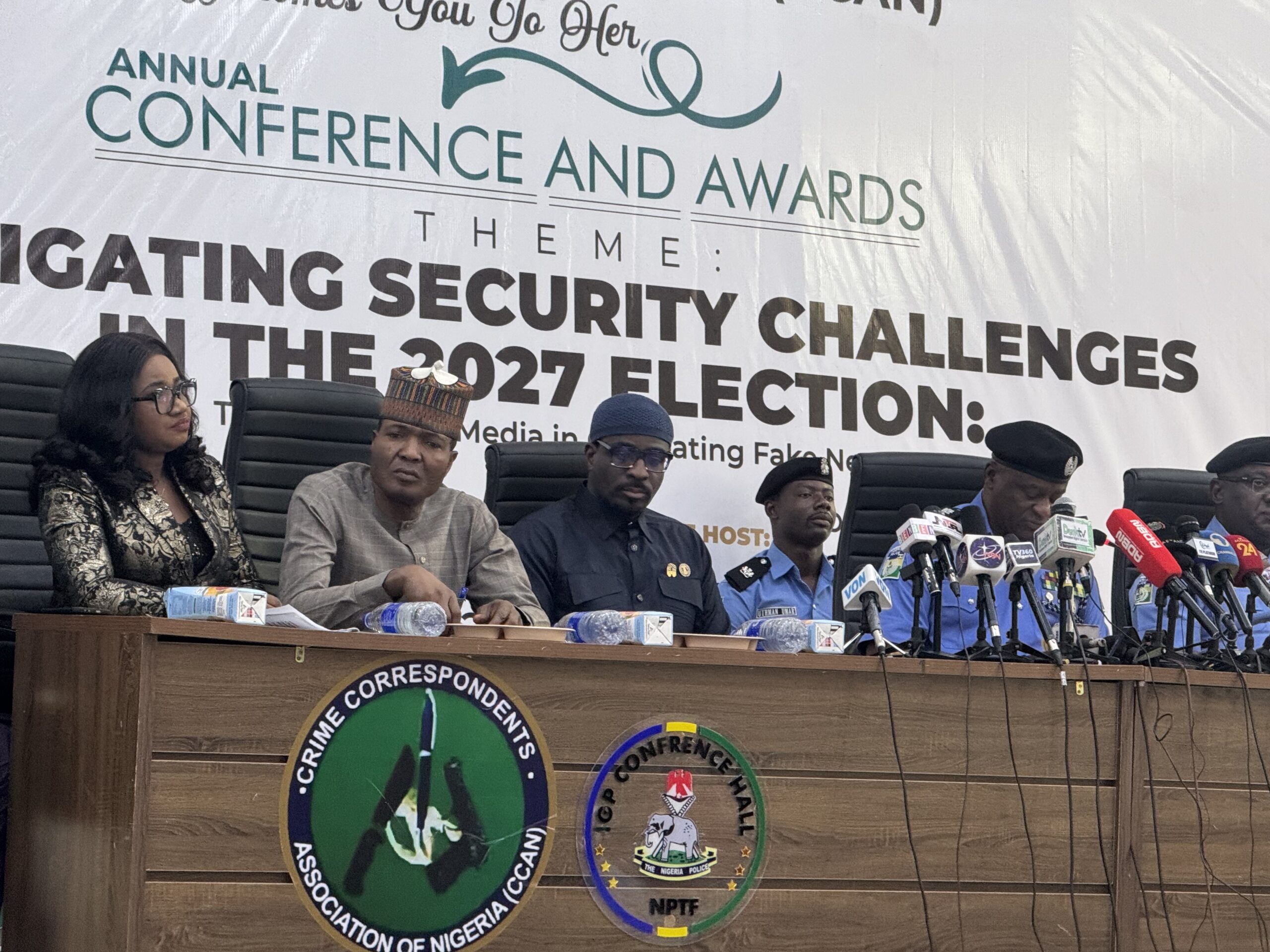
At Annual Conference and Awards, stakeholders warn against fake news, demand improved police capacity and better welfare for journalists ahead of 2027 elections.
The Inspector-General of Police, IGP Olatunji Rilwan Disu, has underscored the importance of crime correspondents and responsible media reporting in promoting public safety, strengthening security communication and addressing the challenges facing the country ahead of the 2027 general elections.
Disu made the remarks at the Annual Conference and Awards of the Crime Correspondents Association of Nigeria (CCAN) in Abuja, where he acknowledged the contributions of crime reporters and the importance of their work in informing the public about security issues. He expressed appreciation to the association and other participants, while wishing the conference success.
The gathering, which brought together senior police officers, media executives, journalists and other stakeholders, focused on the theme, “Navigating Security Challenges in the 2027 Election: The Role of the Media in Combating Fake News.”
The conference provided a platform for discussions on the responsibility of the media in promoting credible information, strengthening public confidence in security institutions and preventing the spread of false narratives capable of generating tension before, during and after the 2027 elections.
In his opening address, the National Chairman of CCAN, Festus Fifen, described the conference as a timely intervention, noting that Nigeria was approaching another important electoral period when political activities, security concerns and the circulation of unverified information could create serious challenges for the country.
Fifen warned that fake news, manipulated media content and rumours could trigger communal clashes, disrupt security operations and undermine public confidence in electoral institutions. He stressed that the fight against insecurity must extend beyond physical security to include the information space, where false narratives could spread rapidly and influence public perception.
He explained that crime correspondents occupy an important position in the security architecture because their reporting helps inform citizens about criminal activities, security operations and developments affecting public safety. According to him, journalists also play a significant role in holding security institutions accountable and ensuring that the public receives information on matters affecting their communities.
The CCAN chairman noted that crime reporters frequently work in difficult and dangerous environments, particularly when covering conflict situations, criminal investigations and security operations. He said journalists often put their lives at risk to provide information to the public, despite inadequate welfare arrangements, protective equipment, specialised training and logistical support.
He expressed concern that some media practitioners were still treated as unwanted guests at official security events, even when their presence and professional coverage were expected. He maintained that journalists should be respected as partners in national development and security communication rather than being regarded merely as recipients of souvenirs and occasional handouts.
“Journalism cannot feed on souvenir, and capacity cannot be built on a plate of rice and periodic handouts,” Fifen said, calling for deliberate investment in journalists’ welfare and professional development.
He urged security agencies and relevant stakeholders to provide safety kits, protective clothing, life insurance and other necessary support for crime correspondents covering high-risk assignments. He also called for the establishment of modern press centres equipped with reliable internet facilities and real-time verification tools to enable journalists to confirm information before publication.
On the approaching elections, the CCAN chairman urged journalists to embrace conflict-sensitive reporting and avoid sensational headlines capable of inflaming ethnic, religious or political tensions. He stressed that while the media must continue to hold public institutions accountable, its reporting should not create unnecessary panic or worsen existing security challenges.
Fifen also appealed to security agencies to involve crime correspondents in pre-election security simulations and other relevant planning activities. He said such engagement would improve information sharing, strengthen communication strategies and help journalists understand the security procedures and challenges associated with election operations.
The chairman commended IGP Disu for what he described as his open-door approach and recognition of the media as an important partner in security management. He also announced the association’s decision to make the Inspector-General of Police its patron, in recognition of his relationship with the media and support for professional engagement.
Speaking at the event, the Executive Secretary of the Nigeria Police Trust Fund, Alhaji Mohammed Sheidu, reaffirmed the Fund’s commitment to strengthening the Nigeria Police Force through improved training, equipment, technology, institutional capacity and personnel welfare.
Sheidu disclosed that the Inspector-General of Police had launched a nationwide election security training programme for police officers about three weeks before the conference, adding that the exercise was still ongoing as part of preparations for the 2027 general elections.
He explained that the training was important in preparing police personnel for the security demands of the electoral period, stressing that officers must be adequately trained, equipped and motivated to protect lives, maintain public order and provide security throughout the election process.
The NPTF Executive Secretary also warned that fake news and disinformation could create panic, weaken public confidence in security institutions and threaten national stability. He maintained that a professional and properly equipped police force was essential to ensuring a safe environment for citizens and the smooth conduct of democratic activities.
He described national security as a collective responsibility that required cooperation among government institutions, security agencies, the media and members of the public. He therefore urged journalists to maintain constructive engagement with security organisations while upholding the principles of accuracy, fairness and accountability.
Also speaking, the Chairperson of the Nigeria Union of Journalists, FCT Council, Comrade Grace Ike, identified fake news and disinformation as major threats to election security, particularly with the increasing use of digital platforms to circulate manipulated videos, fake electoral documents and unverified reports of attacks.
Ike urged journalists to verify the sources, dates and locations of information before publication, advising them to cross-check security-related reports with the police, Department of State Services, Nigeria Security and Civil Defence Corps, community leaders and eyewitnesses.
She cautioned against relying solely on social media posts or information circulated through unofficial channels.
She further warned that not every criminal incident recorded during an election period should be presented as election-related violence, noting that inaccurate reports could create misleading narratives and heighten tension. She emphasised that journalists must place accuracy above the pressure to publish breaking news, stressing that unverified information should not be allowed to mislead the public.
The NUJ FCT chairperson also raised concerns about the safety of journalists covering elections and security operations, noting that reporters could face harassment, intimidation and physical attacks while carrying out their professional duties. She assured media practitioners that the union would continue to engage security agencies on the need to protect journalists and uphold media freedom.
She advised journalists covering volatile locations to work in teams, keep their newsrooms informed of their whereabouts, wear valid press identification and avoid entering dangerous areas alone. She also urged security agencies to provide timely and accurate information to journalists, explaining that a lack of official communication could create information gaps that purveyors of fake news might exploit.
Ike called on the media to educate voters, debunk falsehoods, promote peaceful participation and hold political actors, security agencies and journalists accountable for their actions. She maintained that the credibility of the 2027 elections would depend not only on the conduct of political parties and electoral institutions but also on the quality of information available to citizens.
She urged journalists to remain committed to professional ethics and responsible reporting, reinforcing her message with the words, “Truth first, speed second.” She also cited the Voice of Nigeria newsroom motto, “When in doubt, leave out,” as a reminder that information that cannot be verified should not be published.
The conference also featured the participation of Mallam Jibrin Baba Ndace, Director-General of Voice of Nigeria, alongside other media executives and dignitaries, including a rector who attended the gathering. Their presence reflected the importance of bringing together institutions within the media and public service sectors to discuss the role of credible information in national security.
The event also featured an award and recognition ceremony in honour of individuals whose contributions to public service, security and professional development were considered deserving of recognition. The Inspector-General’s aide was among those recognised, receiving an award and being decorated during the ceremony.
The Annual Conference and Awards ended with renewed calls for improved journalists’ welfare, stronger police capacity, responsible journalism and sustained cooperation between the media and security institutions. Participants emphasised that safeguarding the 2027 electoral process would require more than security deployment, as the country must also protect the information environment from falsehoods, manipulation and narratives capable of threatening peace.

