

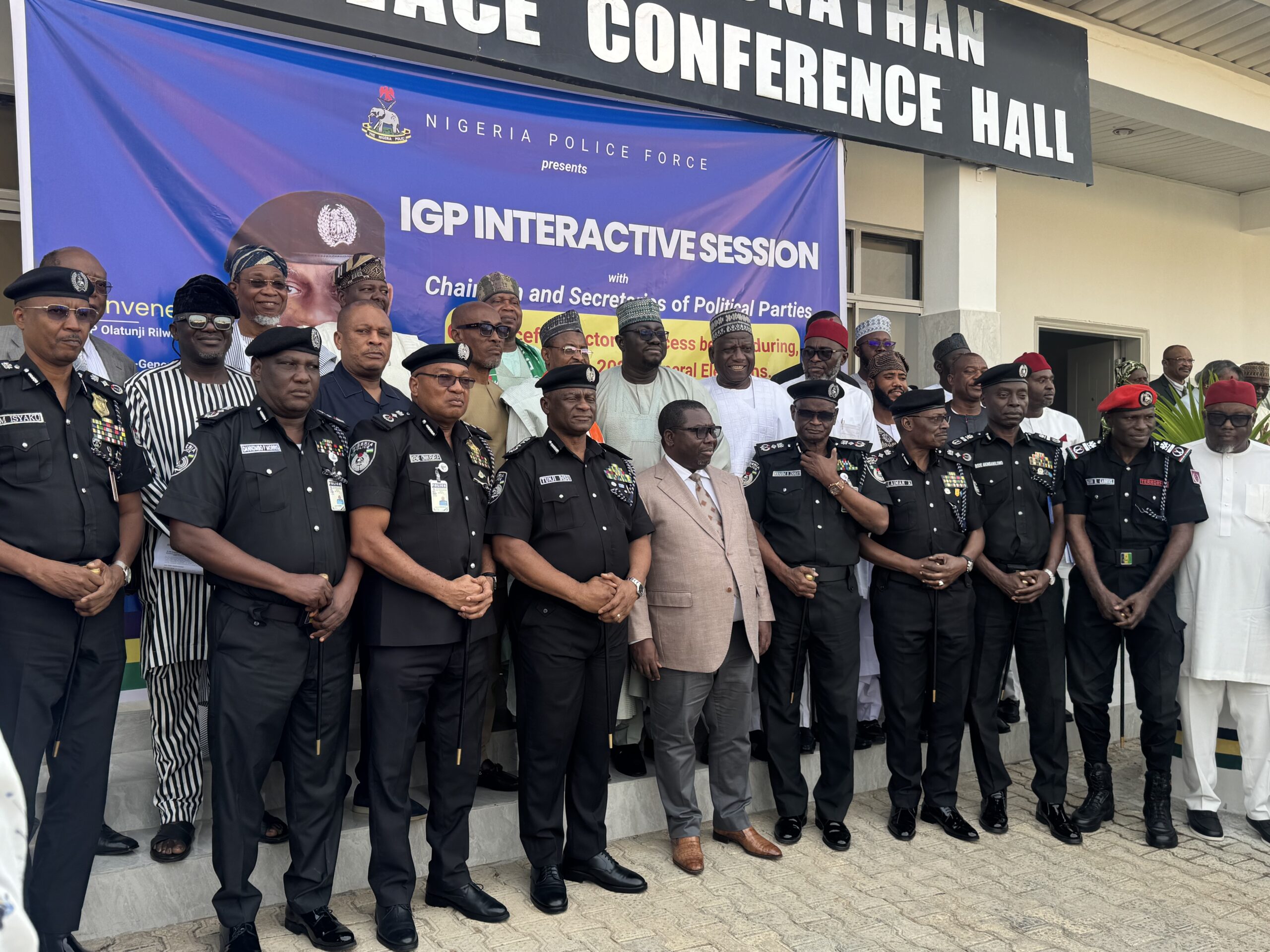
IGP tells party leaders that political influence will not shield sponsors of thuggery, while INEC warns that rising violence could undermine voters’ participation and the credibility of the elections.
By Rejoice Peterside
The Inspector-General of Police, Olatunji Rilwan Disu, has warned politicians sponsoring, financing or directing acts of political violence that they will face the full weight of the law, declaring that no political office or influence will shield anyone from prosecution ahead of the 2027 general elections.
Disu gave the warning on Tuesday at a high-level stakeholders’ meeting on political violence and security during political activities, held at the Goodluck Ebele Jonathan Peace Conference Hall, Force Headquarters, Abuja. The meeting brought together the Chairman of the Independent National Electoral Commission, Professor Joash Ojo Amupitan, SAN, representatives of registered political parties, senior police officers and other stakeholders to discuss measures for preventing violence before, during and after the elections.
The meeting came amid growing concerns over violent clashes among political supporters, attacks on campaign venues and convoys, intimidation of opponents, destruction of political materials and the use of dangerous weapons during political activities. Disu described the incidents as serious threats to public peace and national security, warning that allowing them to continue could endanger lives and weaken public confidence in the electoral process.
“Political competition must never become justification for violence,” the IGP said, stressing that democracy should allow Nigerians to express their political preferences, support candidates of their choice and hold different opinions without fear or intimidation. He warned that elections must not become a contest over which political group could mobilise more thugs, deploy more weapons or inflict greater harm on opponents. “No political ambition is worth the life of a Nigerian, and no electoral victory is worth the destruction of our national peace,” he said.
Disu said the position of the Nigeria Police Force was clear: zero tolerance for political violence and strict neutrality in the electoral process. He explained that the Force owed its allegiance to the Constitution, the law and the Nigerian people, not to any political party, candidate or individual. He assured parties that the police would protect their rights to organise lawful rallies, hold meetings and participate in the democratic process, but would act decisively against anyone whose conduct threatened public peace.
The police chief specifically warned political actors against recruiting, financing or deploying thugs to intimidate opponents, disrupt campaign activities or influence the electoral process. He said responsibility would not be limited to those who physically carried out attacks, adding that those who sponsored, financed or directed violence would also be held accountable. According to him, political status, party affiliation and personal influence would not place anyone above the law.
His warning is backed by existing provisions of the Electoral Act 2022. Section 92 prohibits certain conduct during political campaigns, including the use of abusive or inflammatory language likely to provoke violent reactions. It also prohibits political parties, aspirants and candidates from organising, training or equipping groups to use physical force or coercion to advance political interests. Section 93 further prohibits threats of force or violence during campaigns to compel people to support or refrain from supporting a political party or candidate.
The Constitution also provides safeguards against the use of violence to advance political interests. Section 227 of the 1999 Constitution, as amended, prohibits the formation or use of an organisation for the purpose of promoting political objectives through force or displaying physical force or coercion. Sections 39 and 40 protect freedom of expression and peaceful assembly and association, while Section 14(2)(b) identifies the security and welfare of the people as the primary purpose of government. These provisions reinforce the responsibility of political actors and public institutions to protect citizens’ participation in democratic activities.
However, Disu stressed that the responsibility for peaceful elections could not be transferred entirely to the police. He urged national chairmen of political parties to take ownership of the conduct of their candidates, officials, youth wings and supporters, insisting that instructions against violence must be communicated and enforced throughout party structures. He also called on national secretaries to ensure effective communication and compliance with notification requirements for political activities.
He particularly charged youth leaders to mobilise young Nigerians for constructive democratic participation rather than expose them to manipulation and violence. According to him, political leadership must include the courage to restrain supporters and condemn misconduct, even when those responsible belong to the same political party. He also urged parties to respect the rights of their opponents to campaign, organise meetings and participate in lawful political activities.
The IGP assured political parties that the police would provide adequate security for legitimate rallies and processions and work with INEC to address conflicting campaign schedules that could lead to confrontations. He urged parties to give the required advance notifications and cooperate with security agencies, stressing that peaceful political engagement would be protected while unlawful conduct would be firmly addressed.
Disu further reminded political actors that their responsibilities would extend beyond campaigns and election day. He urged party leaders to discourage vote-buying, ballot snatching, attacks on electoral officials and interference with electoral materials, adding that Nigerians must be allowed to exercise their voting rights freely. He also called on political parties to demonstrate restraint after results were announced and pursue disagreements through lawful judicial processes rather than violence or reprisals.
To strengthen security preparations, the IGP said the police would improve intelligence gathering, operational readiness and collaboration with INEC and other security agencies. He said officers deployed for election-related duties would be guided by professionalism, impartiality and respect for the fundamental rights of citizens. The meeting, he explained, was intended to move beyond general appeals for peace and establish clear responsibilities and practical commitments for political parties ahead of the elections.
One of the major outcomes proposed at the meeting was a Joint Peace and Security Undertaking through which political parties would commit themselves to rejecting violence, respecting the rule of law and protecting lives and property. Disu urged party leaders to ensure that the commitments were communicated and implemented across their organisations, warning that the document must not become an agreement signed merely for public display. “There must not be documents signed for public display and subsequently abandoned,” he said.
The urgency of the meeting was further highlighted by the deadly violence at Uduere community in Ughelli North Local Government Area of Delta State on Monday, during a political campaign-related activity. Disu disclosed that six people had lost their lives in the incident, expressing concern that political activities should result in such loss of lives. He said the meeting had been scheduled before the Delta incident but noted that the development reinforced the need for political leaders and security agencies to take the threat of violence seriously.
The police subsequently confirmed that six people were killed and several others injured in the Delta incident. Disu ordered the Delta State Commissioner of Police to conduct a thorough, impartial and evidence-based investigation to establish the circumstances surrounding the shooting and identify those responsible. The investigation is also expected to examine the sequence of events and the deployment and conduct of police personnel at the campaign venue. He directed enhanced security deployment, intelligence-led operations and sustained patrols to prevent further violence.
The incident also drew a strong response from the Nigeria Democratic Congress, which announced its decision to boycott the IGP’s meeting, accusing the police of failing to protect its members from political attacks. The party said it no longer felt safe participating in police-led security engagements, citing the killing of its members in Delta. The allegations against security personnel and the circumstances surrounding the incident remain subject to investigation, while the party’s absence highlighted the challenge of building confidence among political actors ahead of the elections.
In his address, INEC Chairman Professor Amupitan expressed concern over rising political violence, attacks on electoral facilities and assaults on political party members. He said the commission considered the meeting important enough for him and eight national commissioners to temporarily suspend other official activities to attend. He commended Disu for convening the engagement and called for stronger cooperation between INEC, the police and other security agencies to protect the electoral process.
Amupitan, who spoke on compliance with electoral laws and procedures, warned that political violence could undermine the credibility of the 2027 elections by frightening voters and discouraging participation. He said political competition should be about presenting policies and ideas to Nigerians rather than destroying the people whose votes candidates were seeking. “We should not turn our election into a battlefield. We should look at the election as a competitive interviewing job where political parties will have the opportunity to present their policies, their ideas to the populace,” he said.
The INEC chairman further explained that the Constitution vests sovereignty in the people, making it the responsibility of political leaders to seek their support through persuasion and credible programmes. He warned that when citizens could not assemble, campaign, organise themselves or express their views freely, the political process was already compromised before election day. He also identified grassroots security coordination, protection of electoral personnel and sensitive materials, enforcement of electoral laws, security for the forthcoming mock exercise and the fight against security-related disinformation as priority areas requiring stronger cooperation.
Amupitan announced that the presidential and National Assembly elections would hold on Saturday, January 16, 2027, while the governorship and State Houses of Assembly elections were scheduled for Saturday, February 6. He also disclosed that INEC would conduct a nationwide mock accreditation and results-transmission exercise on Saturday, November 28, across the 36 states and the Federal Capital Territory. The exercise is intended to test the commission’s upgraded electoral technology and its accreditation and electronic results-transmission processes ahead of the general elections.
Beyond political violence, Disu addressed gender-based violence and the responsibility of police spokespersons in protecting survivors during the electoral period. He said rape and other forms of violence were criminal matters, not family, cultural or political issues, and must be treated as offences before, during and after the elections. He directed Police Public Relations Officers to adopt survivor-centred communication, protect the identities of survivors and avoid disclosing names, photographs, addresses or other information that could expose them to further harm.
He also cautioned police spokespersons against victim-blaming language, sensational reporting and insensitive comments that could further traumatise survivors. Disu said women journalists covering the elections must receive the same protection as women voters and candidates, noting that an attack on a woman journalist was both gender-based violence and an attack on press freedom. He called for police commanders, divisional police officers and investigators to be trained on survivor-centred approaches and warned that officers who mishandled complaints, demanded money before investigating cases or compromised survivors must be held accountable.
The meeting ended with a challenge to political parties, INEC and security agencies to translate their commitments into practical action. Disu maintained that the police would not take sides in political contests but would take a firm stand against anyone who threatened the peace. “We will not protect political interests; we will protect the Nigerian people,” he declared. With the 2027 elections approaching, the credibility of the process will depend not only on the conduct of INEC and security agencies but also on whether political leaders restrain their supporters, respect the law and allow Nigerians to participate without fear.

