
By peterside Rejoice
The National Assembly Joint Committee on Drugs and Narcotics has declared that the proposed N75.6 billion allocation to the National Drug Law Enforcement Agency NDLEA in the 2026 budget is grossly insufficient to confront Nigeria’s deepening drug crisis, warning that continued funding gaps could worsen national insecurity.
At the agency’s budget defence session, lawmakers raised concerns that despite the established link between drug abuse and violent crime, the NDLEA continues to grapple with poor capital releases, weak infrastructure and limited operational equipment.
The committee disclosed that no capital funds were released to the agency in 2025, a situation members described as alarming and harmful to ongoing projects across the country.
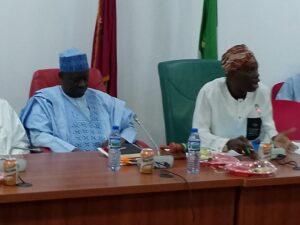
Chairman of the committee, Senator Ibrahim Hassan Dankwambo, alongside Co Chairman Hon Abass Aboworin Adigun, led the review of the agency’s 2025 performance and 2026 proposal after a presentation by NDLEA Secretary Shadrach Haruna.
Adigun said the agency should rank among Nigeria’s top security priorities, stressing that drug abuse is closely connected to violent crimes nationwide.
“This agency should be among the top national priorities. At least 50 per cent of insecurity in Nigeria is linked to drug abuse. Yet we are not funding it accordingly. If we fail to act now, the implications in the next decade will be severe,” he said following a closed door session.
Lawmakers criticised the N388.59 million capital allocation contained in the 2026 proposal, describing it as grossly inadequate for an agency with nationwide enforcement, rehabilitation and prevention responsibilities. They noted that key projects, including construction and rehabilitation of state commands, counselling centres and procurement of operational equipment, have stalled due to financial constraints.
Members also faulted vague descriptions in the budget. A line item titled Construction of Habitation through Counselling Centre generated confusion, with legislators demanding clarity on whether it referred to new construction or renovation. Allocations for ambulances, body scanners and laptops were similarly queried, with lawmakers insisting on clear quantities and specifications in line with modern budgeting standards.
The overall N75.6 billion proposal was widely described as inadequate for an agency confronting a drug abuse prevalence rate of 14.4 per cent, nearly three times the global average according to United Nations data. Senator Baba Njide Husseini warned that substance abuse is increasingly affecting families, women and children.
“Most violent crimes we face today are linked to substance abuse. How do you expect this agency to function without capital releases?” he asked.
Lawmakers further highlighted the poor state of NDLEA facilities in several states, citing the command in Jos, Plateau State, as an example. A proposed N24 million renovation allocation was described as unrealistic considering the condition of the facility.
In his response, Haruna acknowledged the funding challenges but outlined operational achievements recorded by the agency. He disclosed that drugs valued at about N550 billion were seized, while 640 hectares of illicit cannabis farms were destroyed nationwide.
He explained that personnel costs reflected staff promotions and a new compensation structure, resulting in a 1.6 per cent increase over the previous baseline. On capital funding, he stated that only 30 per cent of the 2025 allocation was released in the last quarter and largely committed before utilisation, while the remaining 70 per cent would be carried forward into 2026.
Haruna also highlighted international partnerships, particularly with the United States Drug Enforcement Administration, as well as ongoing demand reduction campaigns targeting schools, religious bodies and grassroots communities.
Despite acknowledging the agency’s operational gains, lawmakers maintained that the achievements under severe financial constraints only underscore the urgent need for greater investment. Some members proposed placing the NDLEA on first line charge to guarantee direct statutory funding from the Federation Account, describing the fight against drug abuse as a national security emergency.
The committee resolved to consider alternative funding mechanisms, including an emergency release of two per cent of internally generated revenue, warning that without immediate and substantial financial reinforcement, Nigeria’s efforts to combat drug abuse and related insecurity could remain critically weakened.
About Author


