

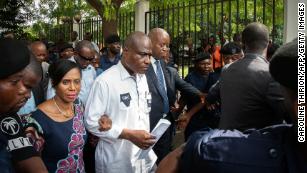
Democratic Republic of Congo opposition leader Martin Fayulu rejected a court ruling Saturday that upheld his defeat in the country’s presidential election, instead declaring himself president-elect.
“I am now considering myself as the sole legitimate President of the Democratic Republic of Congo,” Fayulu said in a statement. “As such, I ask the Congolese people not to recognize any individual who would claim this authority illegitimately nor to obey any orders that would emanate from such a person.”
Fayulu suffered defeat earlier this month when Congo’s electoral commission announced that another opposition leader, Felix Tshisekedi, had won the December 30 vote.
However Fayulu — as well as the country’s Catholic Church — rejected the election results, saying they did not reflect the data collected by observers.
The former oil executive had been widely expected to win the election, which was seen as a test of whether the Central African nation could transition into a democracy.
‘Fayulu calls for ‘peaceful demonstrations’
Fayulu has accused Tshisekedi of colluding with outgoing President Joseph Kabila to influence the votes “against the will of the Congolese people.”
With its decision to uphold Tshisekedi’s election, the constitutional court confirmed that “it is at the service of one individual and of a dictatorial regime that doesn’t respect the laws of the republic nor the most elementary rules of democracy and moral,” Fayulu said in a statement.
Fayulu claims to have won more than 60% of the vote in a “landslide victory” that he said was confirmed by tally sheets and observers.
“It is nothing more than a constitutional coup as (the court) installs a non-elected individual to the highest office,” Fayulu said in the statement.
He asked the international community not to recognize the results and called on the Congolese people to “take its destiny in its hands by organizing peaceful demonstrations across the country” to defend the constitution.
African Union questions election results
The African Union has said it has “serious doubts” about the election results and would send a team to work on “a way out of the post-electoral crisis in the country.”
“The heads of state and government attending the meeting concluded that there were serious doubts on the conformity of the provisional results as proclaimed by the National Independent Electoral Commission, with the verdict of the ballot boxes,” it said in a statement Thursday.
Meanwhile, the Southern African Development Community (SADC) has urged the international community to respect the country’s autonomy.
Democracy in DRC
The December vote was to elect a successor to Kabila, who has held the presidency since 2001
Under the Congo’s Constitution, a president can serve only two terms. Kabila’s second term expired in 2016, meaning the election was long overdue.
Twenty-one candidates including Kabila’s former interior minister, Emmanuel Ramazani Shadary, entered the presidential race.
Out of the opposition candidates, only Fayulu and Tshisekedi were considered to have a serious chance of beating Shadary.
The vote came at a difficult time. The eastern Congo is battling the country’s worst outbreak of Ebola, and violent protests erupted after the Independent National Electoral Commission announced that voters in the Ebola-stricken cities of Beni and Butembo — opposition strongholds — would not cast their ballots until March for security reasons. Yumbi also had elections postponed until March due to violence. It is unclear now how those late votes might affect the result.
If deemed legitimate, the election would be the country’s first democratic transition of power since it gained independence from Belgium in 1960.
Source: CNN

