
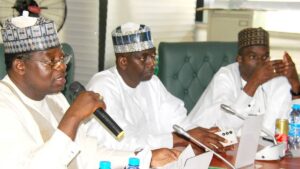
The House of Representatives Ad hoc Committee investigating Nigeria’s power sector reforms and financial expenditures from 2007 to 2024 has issued a decisive directive to the Central Bank of Nigeria (CBN), the Transmission Company of Nigeria (TCN), and SERPLAST Gas Company to submit all outstanding documents by Tuesday, December 9, 2025.
The order was given by the committee’s chairman, Hon. Ibrahim Almustapha Aliyu, during the resumed investigative hearing held at the National Assembly Complex, Abuja. Aliyu said the submission of the documents—including full financial transaction records, payment histories, loan beneficiaries, agreements, and evaluation reports—was “mandatory and non-negotiable.”
Aliyu emphasized that the three institutions are central to understanding why billions of naira invested in the power sector have produced minimal results for citizens who continue to suffer epileptic electricity supply.
“The CBN, TCN, and SERPLAST Gas Company played strategic roles in the sector’s reform process. Their cooperation is essential for us to uncover the gaps, assess the failures, and recommend lasting solutions,” he stated.
The chairman expressed concern that despite repeated reforms and massive financial interventions over the past decade, the Nigerian power sector remains unstable, inefficient, and far from meeting national demand. He added that the privatization exercise had failed to deliver expected improvements in electricity generation, transmission, and distribution.
During the hearing, Deputy Director of the CBN’s Development Finance Department, Abdulrahman Hassan, informed lawmakers that the apex bank had provided several intervention loans to power sector operators as part of efforts to stabilise and expand electricity infrastructure.
Hassan explained that the intervention programs—including “Save Life 1” and “Save Life 2”—were designed to support power generation and distribution companies. He maintained that the bank acted strictly within its regulatory mandate.
Also speaking, CBN official Huseni Idris disclosed that all intervention funds carried a 10-year repayment plan, and most beneficiary companies had shown encouraging repayment performance. He noted that Yola Electricity Distribution Company was given a three-year extension due to severe insecurity within its operational states.
Idris assured the committee that the bank would submit all pending documents at the next adjourned date, including details of disbursements to transmission and distribution companies.
Appearing before the panel, TCN representative Ajiboye Oluwagbenga requested a one-week extension to compile and submit the full documentation required. He highlighted TCN’s key role in strengthening the nation’s power infrastructure through ongoing expansion projects, expressing optimism that electricity supply would gradually improve upon their completion.
On his part, James Makinde, representing SERPLAST Gas Company, appealed for legislative support, stating that the company was experiencing severe financial constraints in sustaining gas supply to power plants—an essential component of Nigeria’s power generation chain.
The committee reaffirmed its commitment to transparency and accountability, insisting that every sector player must provide clear and verifiable records to enable a thorough review of the multi-billion-naira reforms and interventions in the power sector.
The investigation continues next week as lawmakers await the mandatory submissions.
About Author


