
By peterside Rejoice
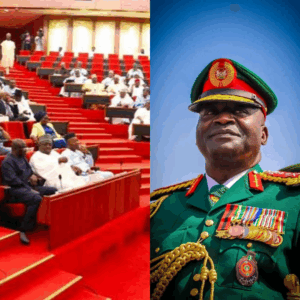
The Nigerian Senate on Wednesday confirmed former Chief of Defence Staff, General Christopher Gwabin Musa, as Minister of Defence following an intense three-hour screening session marked by rare bipartisan firmness, heated debates, and rigorous questioning on the country’s worsening security challenges.
The session began with a mild drama when Senator Sani Musa suggested that General Musa should simply “take a bow and go,” arguing that most discussions about national security had already taken place behind closed doors. His suggestion was met with loud protests from other senators, many of whom insisted that the nominee must be thoroughly interrogated.
Senate President Godswill Akpabio intervened, reminding lawmakers of Senate rules and stressing that Nigerians were watching closely. “This is not a time for bow and go,” Akpabio declared. “Our constituents are asking questions. Our children, brothers, and sisters are in the bush. We must get answers.”
The senators’ questions covered a wide range of issues, including defence funding, intelligence failures, rising banditry, terrorist infiltration, and recent lapses in military operations.
Akpabio also raised concerns over alleged security orders directing troops to withdraw ahead of a school kidnapping in Kebbi, questioning who leaked sensitive operational information involving a senior military officer.
Deputy Senate President Barau Jibrin noted that insurgency in Nigeria had been receding before controversial statements by former U.S. President Donald Trump reportedly escalated tensions, and he commended President Bola Tinubu for stabilising troubled regions such as Monguno in Borno State.
Responding to the questions, General Musa was firm and unequivocal. He stressed that there would be no negotiations with criminals, that ransom payments must cease, and that the fight against insecurity could not be won by the military alone.
Musa emphasised the need for good governance, justice, and equity as essential tools in the security fight, arguing that only a small portion of the battle was kinetic. “Only 25 to 30 per cent of this war is kinetic,” he said. “The rest is governance. Security is local. We must carry the people along.”
On technology and intelligence, Musa admitted that the Armed Forces still faced significant gaps and pledged urgent reforms to bridge them. He called for improved technology, better coordination among security agencies, and stronger community engagement to end the mass kidnapping of schoolchildren, adding that delays in terrorism and kidnapping trials had demoralised security personnel.
Addressing the capture of a brigade commander by insurgents, Musa warned that the military would not tolerate lapses and promised that all investigations would be thorough, with anyone found culpable facing the law.
Senators probed Musa further on the apparent inability of the military to match the superior firepower of bandits.
Senator Abdul Ningi asked why criminals were equipped with more sophisticated weapons while Nigerian officers were still using AK-47s. Musa acknowledged the gaps and assured the Senate that efforts were underway to strengthen technology integration, improve intelligence gathering, and ensure that future operations would be more effective.
Former Senate Leader Ali Ndume urged Musa to prioritise predictable defence funding to eliminate bureaucratic delays and to improve welfare for troops, noting that Nigerian soldiers rank among the lowest paid in West Africa.
Musa responded that strict vetting would continue for recruits, ensuring that former insurgents would not gain entry into the Armed Forces, and that a unified national database would prevent criminals from evading capture by simply relocating.
The Defence Minister-designate also outlined operational strategies, including the redeployment of troops to track terrorists in forests and hideouts, while routine checkpoints would be handed over to police and civil defence.
He stressed the importance of close collaboration with governors and relevant ministries, aggressive community engagement in troubled areas such as Maiduguri, and tackling illegal mining linked to terrorist financing.
Musa further highlighted the need for expanded maritime security under Operation Delta Safe, improved border surveillance, and the protection of farmlands to ensure food security.
Acknowledging the weight of public expectations following his nomination, Musa admitted: “I felt the heat when my name was announced. I cannot afford to fail myself, my nation, or my family.”
He vowed to instil strict professionalism within the Armed Forces, emphasising zero tolerance for indolence and cowardice. “These are evil forces with no respect for human life,” he said. “Nigerians must work together. We will face them squarely and stop the killings.”
In a significant development, Senate President Akpabio disclosed that the upper chamber had commenced the process of designating kidnapping as a terrorist offence punishable by death without the option of a fine. “We are giving you the enabling framework,” he told Musa. “If they are not deterred, they will face the death sentence.”
By the end of the marathon session, General Musa emerged with the Senate’s confidence, having demonstrated readiness to tackle Nigeria’s security challenges while advocating for reforms that combine military action, governance, and community participation.
His confirmation is widely seen as a critical step in strengthening Nigeria’s national security architecture and empowering the Defence Ministry to act decisively against insurgency, banditry, and terrorism.
–
About Author


