

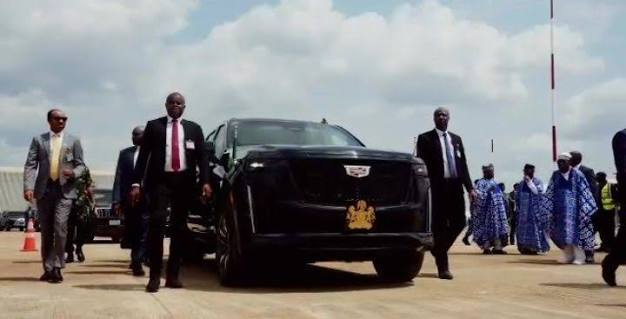
Tracka has raised concerns over the Federal Government’s 2026 budget, revealing that N962.83bn has been set aside for the purchase of Sport Utility Vehicles (SUVs) and empowerment projects, despite plans to finance a large share of the budget through borrowing. The civic technology organisation said the 2026 budget allocates N15.13bn for the procurement of 39 SUVs and N947.70bn for 2,579 empowerment projects. According to Tracka, the 2026 budget allocation exceeds the combined N960.27bn earmarked for seven key federal ministries.
The organisation noted that the Ministry of Industry, Trade and Investment received N156.8bn, Housing and Urban Development got N145.3bn, Women Affairs was allocated N169.39bn, Justice received N150.7bn, Livestock Development got N177.6bn, Aviation and Aerospace Development received N87.3bn, while Petroleum Resources was allocated N73.1bn.
Tracka also questioned the transparency of the empowerment projects, revealing that only 70 of the 2,579 projects have clearly identified implementation locations.
“Yet, only 70 of the 2,579 empowerment projects have clearly identified implementation locations.”
The organisation said the lack of project locations makes it difficult for citizens, oversight institutions and taxpayers to monitor spending or verify who benefits from the allocations. It further noted that the projects are spread across 184 implementing agencies, including several whose primary responsibilities do not normally include empowerment programmes.
Its review showed that the Federal Cooperative College, Oji River, was assigned 393 projects worth N127.1bn, while the National Agricultural Development Fund received six projects valued at N89.5bn. The Federal College of Horticulture, Dadin-Kowa, Gombe, was allocated 216 projects worth N88.1bn, while the Federal Cooperative College, Ibadan, received 94 projects valued at N36.9bn.
The largest single allocation, according to the report, is N89.09bn for the Renewed Hope Fertiliser Support Programme under the National Agricultural Development Fund. Other major allocations include N14bn for the procurement and distribution of economic empowerment equipment and utility vehicles through the Federal Cooperative College, Oji River, N14bn for youth empowerment programmes under the Federal Ministry of Youth Development, and another N14bn for youth empowerment and medical outreach under the Ministry of Humanitarian Affairs and Poverty Alleviation.
The budget also provides funding for buses, tricycles, motorcycles, electric vehicles, sewing machines, fertilisers, vocational equipment, grants and other empowerment items across different parts of the country.
While acknowledging the importance of empowerment programmes, Tracka stressed that they must be carefully designed and transparently implemented.
“Let us be clear, there is nothing inherently wrong with empowerment programmes! When well-designed and transparently implemented, they can improve livelihoods, create economic opportunities, and support vulnerable Nigerians.”
The organisation warned that poorly defined projects have often become channels for political patronage instead of delivering broad public benefits.
“Experience over the years has shown that many poorly defined empowerment projects have become vehicles for political patronage, rewarding loyalists rather than delivering broad-based benefits to citizens. When projects have no clear location, no transparent beneficiary selection process, and are assigned to agencies without the appropriate mandate, public confidence is eroded, and accountability becomes difficult,” the organisation stated.
Tracka added that these concerns are even more significant because the 2026 budget is expected to be financed with a deficit of about 46 per cent.
“This concern is even more pressing given that the 2026 Budget is projected to be financed with a deficit of about 46 per cent. At a time when government is borrowing heavily to fund public expenditure, every naira should be directed toward investments with clear development outcomes, measurable impact, and value for money, not opaque allocations that citizens cannot effectively track.”
The organisation called for greater transparency in future budgets, insisting that every budget item should have a clear purpose, location, implementing agency, identifiable beneficiaries and measurable outcomes.
According to Tracka, “A budget should not only allocate resources, it should also inspire public confidence. Every budget item should have a clear purpose, a defined location, an implementing agency with the legal mandate to deliver it, identifiable beneficiaries, and measurable outcomes.”
Do you think stricter transparency measures would improve public confidence in Nigeria’s budget implementation?

