

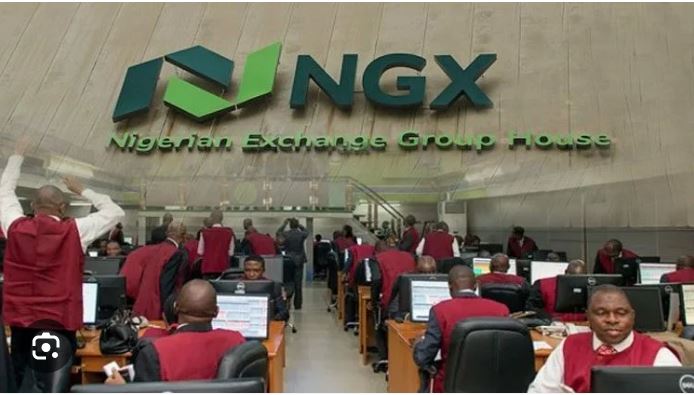
The Nigerian stock market started the trading week on a negative note on Monday as heavy sell-offs in banking, industrial and consumer goods shares wiped N767.36 billion off investors’ wealth.
The market’s total value fell by 0.48 per cent to N160.04 trillion, down from N160.80 trillion recorded at the close of trading on Friday, November 20, 2026.
Similarly, the NGX All-Share Index dropped by 1,181.84 points to 246,478.90 points, representing a 0.48 per cent decline from its previous close of 247,660.74 points.
The losses mainly came from major banking stocks, including Fidelity Bank, Access Holdings, First Holdco, Zenith Bank and GTCO. Fidelity Bank recorded the biggest decline among the leading financial stocks, falling by 7.34 per cent. Access Holdings lost 2.28 per cent, while First Holdco, Zenith Bank and GTCO dropped by 2.09 per cent, 1.81 per cent and 1.75 per cent respectively.
Consequently, the NGX Banking Index shed 32.80 points to close at 2,266.95 points.
The industrial sector also faced strong selling pressure, with Julius Berger Nigeria Plc falling by 9.97 per cent. This pushed the Industrial Index down by 53.31 points to 11,673.31 points.
Meanwhile, the Consumer Goods Index lost 37.58 points to settle at 3,990.47 points. International Breweries fell by 9.41 per cent, while Honeywell Flour Mills declined by 5.66 per cent. The Oil and Gas Index also dropped by 9.27 points to 5,702.88 points following Oando’s 5.80 per cent loss.
However, the insurance sector moved against the wider market trend, emerging as the only advancing sector with a 2.78 per cent gain. Cornerstone Insurance rose by 10 per cent, while AIICO Insurance and Linkage Assurance gained 9.87 per cent and 9.80 per cent respectively.
Industrial and Medical Gases Nigeria Plc also advanced by 10 per cent, placing it among the day’s five biggest gainers.
Despite the NGX market decline, trading activity increased. Investors exchanged 441.07 million shares in 38,846 deals, representing increases of 44.32 per cent in volume and 31.30 per cent in transactions compared with Friday.
Other market indicators also closed lower, as the Premium, Main Board and Growth indices recorded losses.
Will increased trading activity help the Nigerian stock market recover from the latest wave of selling pressure?

