

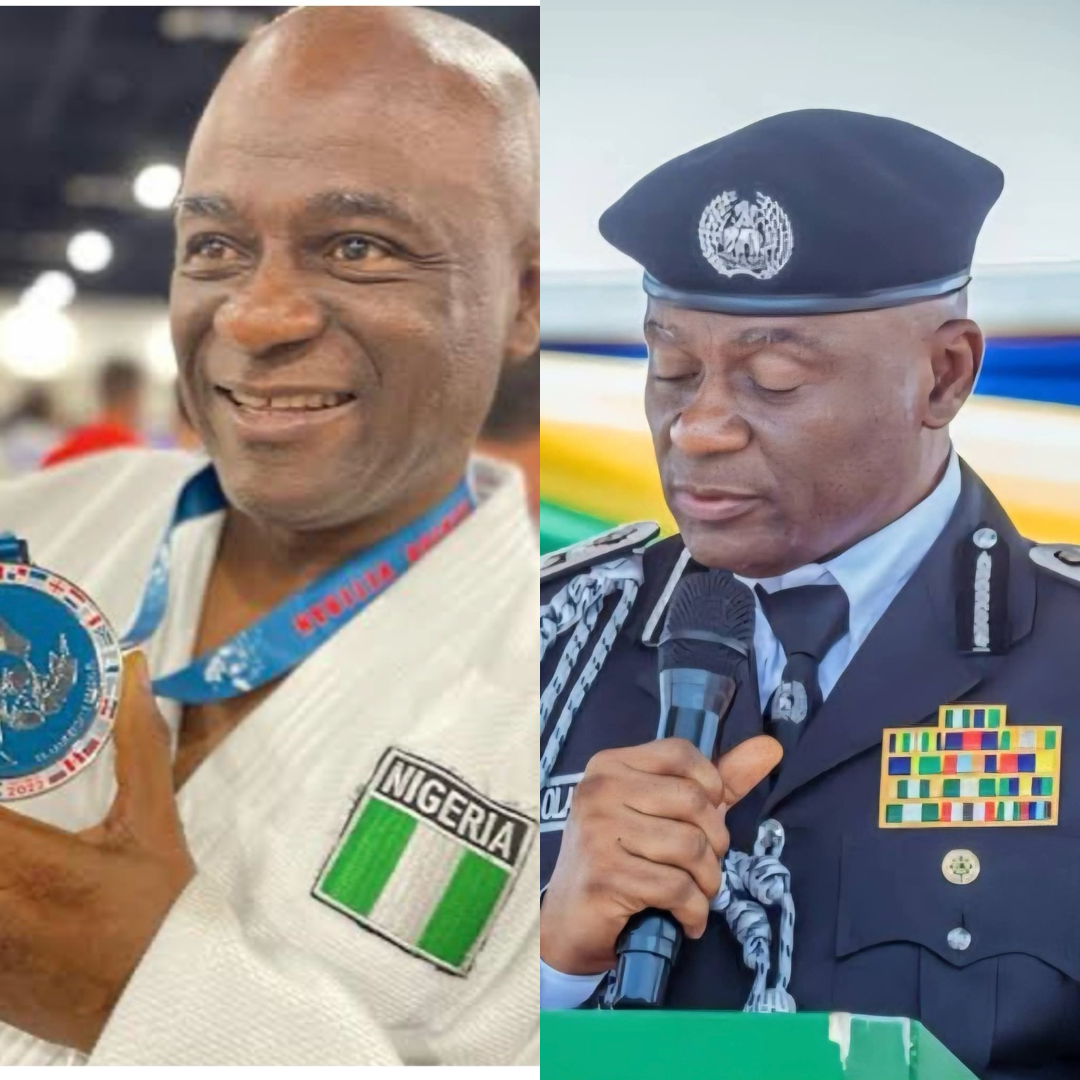
Inspector-General of Police (IGP), Dr. Olatunji Disu, has been elected President of the Nigeria Judo Federation (NJF), pledging to unite stakeholders, restore confidence in the sport and strengthen grassroots development across the country.
Disu emerged unopposed at the federation’s National Elective Congress held on Thursday, November 19, 2026, at the Media Centre of the Moshood Abiola National Stadium, Abuja, securing all 13 votes cast by eligible delegates.
His emergence followed the transition process facilitated by the Sheriff Hammed-led Caretaker Committee, which was constituted following the dissolution of the federation’s previous board by the International Judo Federation (IJF).
The new president has identified reconciliation, youth development, improved funding and international competitiveness as major priorities of his administration.
His election comes with renewed expectations from stakeholders for a more united judo community, improved athlete development and stronger Nigerian representation at international competitions.
Speaking after his emergence, Disu expressed gratitude to delegates for their confidence, describing the occasion as a significant moment in his life, particularly given his career in the Nigeria Police Force, where he said he had never previously participated in an election as a candidate or voter.
He declared that the ultimate winner of the election was Nigerian judo, stressing that the sport was bigger than individual interests and disagreements.
“There is no winner, there is no loser, but there is a winner, and the winner is Judo. Because Judo is bigger than all of us here,” he said.
Disu identified reconciliation as his immediate priority, promising to bring together divided groups within the judo community, including aggrieved stakeholders, former federation presidents, athletes, coaches and other individuals who have contributed to the development of the sport.
He said the reconciliation initiative would extend beyond Nigeria to reconnect with Nigerian judokas abroad who had become disconnected from the country’s judo administration.
According to him, the federation must begin immediately to rebuild relationships and restore unity among stakeholders to create a stronger foundation for the sport.
Beyond reconciliation, the IGP outlined an ambitious grassroots development agenda, promising to concentrate on discovering and nurturing young talents through secondary schools, universities and polytechnics.
Speaking in an interview after his election, he said his administration would return attention to educational institutions, which historically provided a strong foundation for the growth of judo in Nigeria.
“I’m going to channel my energy to bringing up the youth. I’m going grassroots. I’m going to concentrate on all secondary schools, universities and polytechnics because, in the past, this is where we got people to populate the sport of judo,” he said.
He added that the federation would embark on extensive enlightenment campaigns to encourage more Nigerians, particularly young people, to embrace the sport.
Disu described his emergence as a new beginning for Nigerian judo and thanked judokas, sports authorities and other stakeholders for their support.
His return to the federation’s leadership is backed by a longstanding personal involvement in judo, spanning several decades as an athlete and sports administrator.
He began practising the martial art in 1986 and demonstrated his competitive ability at the 1990 National Sports Festival in Bauchi, where he won two gold medals.
He subsequently won two gold medals at the Nigeria Police Games and a silver medal at the Armed Forces Games.
In November 2021, he added another gold medal to his collection at the first veterans’ championship organised by the Nigeria Police Force.
His international profile received further recognition in July 2022 when he won a silver medal in the men’s under-100kg veterans’ category at the 33rd US Open Judo Championship in the United States, an event that attracted more than 500 veteran competitors.
Beyond his achievements on the mat, Disu has served as Chairman of the Lagos State Judo Association and Chairman of the Police Judo Association, contributing to the organisation and promotion of the sport.
He is also a third-dan black belt judoka.
Meanwhile, Sir Nwaobilor Ananaba, a philanthropist, was elected First Vice President of the federation, while Barrister Gbahabo Emmanuel emerged as Second Vice President with 11 votes.
In an interview after his election, Ananaba described the task ahead as a collective responsibility, stressing the need to establish a sustainable development structure that would make judo more popular and competitive at state, national and international levels.
He said the federation would focus on identifying and nurturing athletes capable of representing their states and Nigeria at international competitions.
Ananaba also identified inadequate funding as one of the major challenges facing grassroots sports development, disclosing that the new leadership would engage the private sector and explore sports endowment opportunities to complement government support.
“Grassroots sports is very expensive, but we are ready to make that contact and grow the game,” he said.
He expressed excitement over the confidence reposed in the new leadership, describing the calibre and integrity of the board members as encouraging.
Similarly, Emmanuel said his responsibility as Second Vice President would be to support the president in implementing the administration’s programmes, particularly reconciliation and grassroots development.
He described Disu’s election and the composition of the board as an opportunity to advance Nigerian judo, expressing confidence that the collective experience of its members would contribute to the development of the sport.
Other members of the newly constituted board represent different stakeholder groups, technical and athlete constituencies, as well as Nigeria’s six geopolitical zones.
They include Coach Catherine Ewa Eauta (AFFAN), Mr Bassey Ekanem Ekwere (Paramilitary Representative), Coach Ika Bassey Odo (Technical Representative), Ezeri Agahata (Athlete Representative), Chijioke Okechukwu (NAPHER-SD), David Jesuorobo Osaghae (International Representative) and Dr Lawrence Ezeudu (South-East).
Others are Coach Osahon Eke (South-South), Engr. Tokunbo Ajanaku (South-West), Mrs Rosa Collins (NAWIS), Saliisu Mahmuda (North-West), Barrister Gbahabo Emmanuel (North-Central) and Coach Sunday Ewa (North-East), alongside two co-opted members.
The broad representation is expected to provide different interests within the sport with opportunities to contribute to policy decisions, administration and development programmes.
With inadequate funding remaining a major obstacle to grassroots sports development, the new administration is expected to explore stronger partnerships with private organisations and individuals.
The proposed engagement with corporate organisations and sports investors could help provide resources for athlete identification, training programmes, competitions, coaching development and participation in international events.
For Nigerian judo to compete effectively at the highest level, stakeholders believe that consistent investment in athletes and technical development will be necessary.
Meanwhile, Nigeria Judo Federation Secretary-General, Ngozi Mayo, expressed optimism that the new administration would provide effective leadership and create the conditions necessary for Nigerian judokas to achieve podium finishes at the 2028 Olympic Games.
The target represents a major ambition for Nigerian judo and places additional responsibility on the new leadership to develop a structured athlete preparation programme.
Achieving such a goal would require sustained grassroots talent discovery, quality coaching, regular domestic competitions, international exposure and adequate financial support.
Mayo also announced that the federation’s General Assembly would commence immediately, while the date for the formal inauguration of the new board would be communicated to members.
The election followed a period of administrative challenges within the Nigeria Judo Federation, which prompted the intervention of the International Judo Federation and the National Sports Commission.
The NSC had approved a six-member caretaker committee chaired by Sheriff Hammed following the dissolution of the federation’s previous board by the IJF.
The committee was mandated to oversee the federation’s affairs, facilitate necessary administrative reforms, organise fresh elections and ensure a smooth transition to elected leadership.
Following the election, Hammed congratulated Disu and described the process as the fulfilment of the caretaker committee’s mandate to restore elected leadership to the federation.
He commended stakeholders for their cooperation and urged members of the judo community to unite behind the new administration.
He also acknowledged the support of the National Sports Commission, led by Chairman Shehu Dikko and Director-General Bukola Olopade, in efforts to reposition Nigerian judo.
Disu’s immediate challenge will be to translate his promises of reconciliation, grassroots revival and improved funding into practical programmes that deliver measurable progress.
The proposed return to schools and universities could help expand participation, while private-sector partnerships may provide additional resources for athlete development.
Similarly, reconnecting with Nigerian judokas abroad could create opportunities for technical exchange, mentorship and stronger international relationships.
The ambition of securing podium finishes at the 2028 Olympic Games further underscores the importance of establishing a clear development pathway for Nigerian athletes.
With all 13 eligible delegates voting in his favour, Disu begins his tenure with a mandate from the electoral congress. However, stakeholders will be looking to the new leadership to address the administrative challenges that necessitated the caretaker arrangement and translate its promises into tangible improvements.
For Nigerian judo, the focus now shifts from the election to implementation, as the new administration prepares to unite stakeholders, strengthen the federation and build a stronger future for the sport.

