

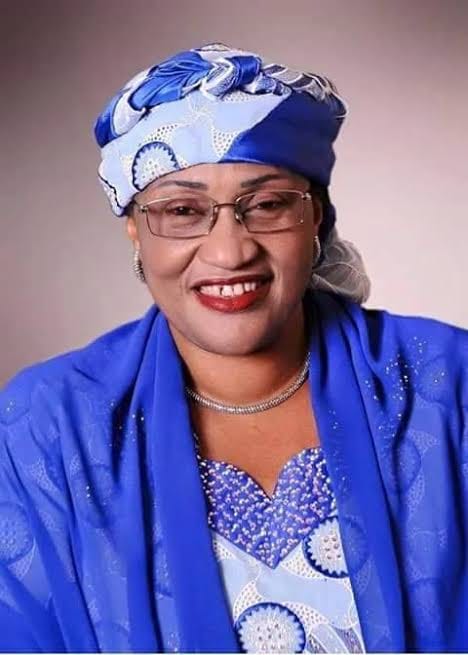
A Global Tribute to Senator Aisha Jummai Al-Hassan (1959–2021): A Life of Courage, Public Service and Enduring Legacy
Honourable Ibrahim Sani
“Some people occupy positions; others transform the meaning of the positions they occupy. Some leave behind titles; others leave behind a history that continues to inspire generations.”
WHEN A REMARKABLE LIFE BECOMES A LASTING LEGACY
There are lives whose significance cannot be confined to the dates of birth and death. They are measured instead by the barriers they break, the institutions they serve, the opportunities they create and the memories they leave in the hearts of those who encounter their stories.
Senator Aisha Jummai Al-Hassan, internationally recognisable by her affectionate Nigerian sobriquet, Mama Taraba, belonged to this category of public figures whose lives intersected law, judicial administration, legislative representation and executive governance.
Born on 16 September 1959 in Jalingo, in present-day Taraba State, Nigeria, she died in Cairo, Egypt, on 7 May 2021, aged 61. Her departure brought an end to a remarkable public career, but it did not erase the significance of the professional milestones she had achieved or the questions her journey continues to raise about women’s leadership in African public life.
Mama Taraba’s story was not simply about occupying important offices. It was about entering institutions where women had historically been underrepresented and establishing a professional record that placed her among the notable female pioneers of her generation.
Her life deserves remembrance not through exaggerated praise, but through a careful appreciation of her achievements, her determination, her public responsibilities and the family whose story remains inseparable from her personal legacy.
CHAPTER ONE: THE MAKING OF A DISTINGUISHED LEGAL MIND
Great professional journeys often begin with an investment in knowledge, sustained by discipline and an enduring willingness to learn.
Mama Taraba’s educational journey led her to Ahmadu Bello University, Zaria, and subsequently to the Nigerian Law School. She was called to the Nigerian Bar in 1986, beginning a legal career that would take her through several important stages of judicial and public service.
In April 1988, she began working as a Grade II Magistrate in the Kaduna State Judiciary. Her subsequent professional experience included service in the Republic of Fiji, where she was admitted to practise law and enrolled as a barrister and solicitor of the High Court of Fiji in 1991. During this period, her professional service was transferred to the Federal Capital Territory Judiciary.
Her career illustrates an important principle: professional distinction is not usually the product of a single appointment. It emerges through years of preparation, responsibility, institutional experience and the willingness to serve wherever one’s expertise is required.
For young Africans pursuing careers in law, governance and public administration, her journey remains a useful reminder that education can open doors across borders and that professional credibility is built through sustained work.
CHAPTER TWO: A TRAILBLAZER IN JUDICIAL ADMINISTRATION
One of the most significant dimensions of Mama Taraba’s legacy was her record of pioneering appointments.
She became the first female Chief Magistrate in the Federal Capital Territory in 1996. In 1997, she was appointed the first female Attorney-General and Commissioner for Justice of Taraba State. She later became the first female Secretary of the FCT Judicial Service Committee in 2002 and the first female Chief Registrar of the High Court of the Federal Capital Territory in December 2003. She voluntarily retired from the judiciary in December 2009.
These milestones represent more than a sequence of professional promotions. They form part of a broader history of women’s gradual advancement within Nigeria’s legal and judicial institutions.
A woman entering a senior position for the first time carries two responsibilities: the duties attached to the office and the symbolic significance of demonstrating that the institution’s doors can open to others.
Mama Taraba’s appointments became part of that history.
Her achievements also invite a broader reflection on leadership. Institutions are strengthened when appointments are based on qualifications, experience, integrity and the capacity to discharge public responsibilities. A pioneering appointment matters most when it contributes to a culture in which future generations can compete on merit rather than being constrained by inherited barriers.
Her judicial career remains one of the strongest pillars of her professional legacy.
CHAPTER THREE: FROM THE JUDICIARY TO THE SENATE
In 2011, Mama Taraba entered another demanding arena of national service when she was elected Senator representing Taraba North Senatorial District in Nigeria’s Seventh National Assembly. She served from 2011 to 2015.
Her transition from judicial administration to electoral politics brought her experience into the legislative environment, where public policy, representation and national development are debated and shaped.
The Senate offered a different platform from the courtroom. In the judiciary, legal questions are addressed through established procedures and the interpretation of law. In the legislature, representatives participate in lawmaking, oversight and the articulation of the interests of their constituents.
Her experience across these distinct institutions gave her career a breadth that extended beyond a single professional discipline.
In 2015, she became the All Progressives Congress candidate in the Taraba State governorship election. An election petition tribunal subsequently declared her the winner, but the appellate courts overturned that decision. She later contested the governorship election in 2019 under the platform of the United Democratic Party.
Her gubernatorial campaigns formed part of her sustained effort to reach the highest executive office in her home state. Although she did not become governor, her candidacies remain part of the history of women’s participation in Nigeria’s competitive electoral politics.
Her story reminds us that public ambition and public achievement do not always culminate in electoral victory. Yet the significance of a political journey can also lie in the questions it raises, the barriers it challenges and the experiences it contributes to the democratic process.
CHAPTER FOUR: FEDERAL MINISTER AND ADVOCATE FOR WOMEN’S DEVELOPMENT
In November 2015, President Muhammadu Buhari appointed Mama Taraba Minister of Women Affairs and Social Development. She served until her resignation in 2018.
The ministry’s responsibilities placed her within Nigeria’s national policy framework for women’s welfare, social development, children’s well-being and the advancement of vulnerable groups.
Her tenure coincided with continuing national debates about gender equality, women’s economic opportunities, violence against women and girls, and the protection of children.
The office offered an important platform from which these issues could be addressed through public engagement, government programmes and collaboration with relevant institutions.
The Ministry of Women Affairs operates within a complex social environment in which progress depends on sustained funding, effective implementation, cooperation among government agencies and the involvement of communities. No single minister can resolve every structural challenge within one tenure.
Nevertheless, the position held by Mama Taraba placed her at the centre of a national conversation about the dignity, protection and advancement of women and children.
Her contribution should be remembered within that institutional context, alongside the continuing work required to improve access to opportunity and protection for vulnerable Nigerians.
Her ministerial service also broadened the public dimensions of her career. Having previously worked in judicial administration and legislative politics, she brought experience from both institutions into the executive branch.
This combination of legal, legislative and ministerial experience distinguished the different chapters of her public life.
CHAPTER FIVE: THE COURAGE TO ENTER THE ARENA
Mama Taraba’s political history included both advancement and disappointment, appointments and departures, campaigns and contested outcomes.
Such a career cannot be understood adequately through titles alone. Public life involves difficult decisions, changing political circumstances and the challenge of reconciling personal convictions with institutional expectations.
Her departure from the Buhari cabinet in 2018 and her subsequent return to electoral politics marked another turning point in her public journey. Her later governorship campaign demonstrated her continued commitment to political participation.
The significance of her life is not that every ambition was fulfilled. Rather, her story illustrates the complexity of a public career in which professional accomplishment and political uncertainty existed side by side.
A balanced tribute acknowledges both the offices she held and the ambitions that remained unrealised. It recognises the milestones without rewriting the historical record.
In doing so, it gives her legacy something more valuable than exaggerated praise: credibility.
CHAPTER SIX: PROFESSOR ANGO ABDULLAHI — THE DISTINGUISHED HUSBAND AND ACADEMIC
Behind the public biography of a national figure lies a private world of family, partnership, sacrifice and shared experience.
In Mama Taraba’s life, Professor Ango Abdullahi occupies an important place.
A distinguished Nigerian academic, former Vice-Chancellor of Ahmadu Bello University, Zaria, and prominent participant in national public discourse, Professor Ango Abdullahi built a substantial career of his own in education and public affairs.
His marriage to Mama Taraba, which began in 1979, connected two lives whose professional experiences became associated with law, education, leadership and public service. A biographical account published by Dateline Nigeria describes how she pursued her education and legal career while raising their children.
Their shared history deserves recognition because it illuminates a dimension of achievement that official records often leave unexplored: the effort required to balance family responsibilities with demanding professional commitments.
For Mama Taraba, the path from university education to judicial leadership, legislative representation and ministerial office unfolded alongside the responsibilities of marriage and motherhood.
For Professor Ango Abdullahi, the memory of their years together forms part of a personal history that public appointments and academic honours cannot fully capture.
To him, this tribute extends a message of respect for a distinguished academic career and heartfelt sympathy for the loss of a wife whose life was woven into the family’s shared story.
May the memories they built together remain a source of strength, and may the family’s enduring bonds offer comfort as they preserve the legacy of the woman they loved.
CHAPTER SEVEN: HON. SADIQ ANGO ABDULLAHI — A SON, A LEGACY AND THE RESPONSIBILITY OF A GOOD NAME
Among those whose lives remain closely connected to Mama Taraba’s legacy, Honourable Sadiq Ango Abdullahi deserves particular recognition in this tribute.
A parent’s legacy is not a script that a child must follow word for word. It is an inheritance of values, experiences and examples from which the next generation may draw wisdom while finding its own direction.
Hon. Sadiq Ango Abdullahi belongs to a family whose history brings together academic distinction, legal accomplishment and participation in public life.
From his father, Professor Ango Abdullahi, the family name is associated with scholarship, university leadership and national discourse. From his late mother, the family remembers a woman who pursued legal excellence, occupied pioneering judicial positions, represented her senatorial district and served in the Federal Executive Council.
These histories create a rich setting in which the responsibilities of family, personal identity and public service intersect.
For Hon. Sadiq, remembering his mother means more than preserving photographs, recounting appointments or recalling the occasions on which she appeared before the public. It also means appreciating the discipline, perseverance and commitment that sustained her professional journey.
His mother’s career offers lessons in preparation before opportunity, courage in the face of uncertainty and the importance of taking one’s responsibilities seriously.
Her story also reminds the younger generation that a distinguished family name is best honoured through personal character, respect for others, continuous learning and meaningful contributions to society.
A name may be inherited, but its enduring honour is sustained by conduct.
That principle gives special meaning to this remembrance of Hon. Sadiq Ango Abdullahi. His place in the family story deserves to be acknowledged with warmth and dignity, not merely because of his parentage, but because every generation has the opportunity to build upon the lessons it receives.
May the memory of his mother remain a source of inspiration, and may he continue to pursue a life that reflects the enduring values of education, responsibility, compassion and service.
CHAPTER EIGHT: HER DAUGHTERS AND THE CONTINUITY OF A MOTHER’S INFLUENCE
Mama Taraba’s daughters also occupy an important place in the legacy she left behind.
The significance of her professional journey is especially meaningful when considered in the context of the opportunities available to the next generation of women.
Her life demonstrated that marriage and motherhood need not erase a woman’s professional ambitions, and that family responsibilities can coexist with a serious commitment to education and public service.
For her daughters, their mother’s story offers a deeply personal example of perseverance and professional advancement. Her achievements in the legal profession and public administration stand as reminders that a woman’s aspirations deserve to be taken seriously.
Yet their inheritance is larger than the public achievements recorded in newspapers and official biographies. It includes private memories, family experiences and the personal influence that no public record can fully measure.
To Professor Ango Abdullahi, Hon. Sadiq Ango Abdullahi, his sisters and the entire extended family, the passing of Mama Taraba represented the loss of a loved one whose place could never be filled by public recognition alone.
Their grief deserves the respect and compassion that accompany every family’s experience of bereavement.
May her children find comfort in their shared memories, strength in their family bonds and encouragement in the knowledge that the influence of a devoted parent can continue across generations.
CHAPTER NINE: BEYOND NIGERIA — THE GLOBAL SIGNIFICANCE OF HER STORY
Although Mama Taraba’s career was rooted in Nigeria, the broader themes of her life extend beyond national boundaries.
Her experience speaks to women in public service across Africa and the world who seek to enter professions historically dominated by men.
It speaks to lawyers who move from professional practice into public administration, to public servants who enter electoral politics, and to leaders who must navigate the demands of family life alongside institutional responsibilities.
It also speaks to societies still examining how to translate formal commitments to gender equality into meaningful opportunities for women.
Her career provides a concrete historical example of a woman occupying senior positions in judicial administration, serving in a national legislature and leading a federal ministry.
These achievements do not eliminate the wider challenges facing women in public life. Instead, they help document the progress made, the possibilities demonstrated and the work that remains.
Her legacy is therefore relevant not because her story should be treated as flawless, but because it offers an opportunity for reflection on leadership, representation, perseverance and the responsibilities of public office.
For the international reader, Mama Taraba’s life provides a window into Nigeria’s institutions and into the personal determination required to build a career across different spheres of national service.
WHEN A LIFE ENDS, ITS LESSONS REMAIN
On 7 May 2021, the life of Senator Aisha Jummai Al-Hassan came to an end in Cairo, Egypt. She was 61. But the significance of her journey did not end with her final breath.
Her history remains preserved in the record of her judicial appointments, her service in the Senate, her tenure as Minister of Women Affairs and Social Development, and her efforts to participate in the political future of Taraba State.
Her family carries a more intimate inheritance: the memories of a wife, a mother and a loved one whose life extended far beyond public office.
Professor Ango Abdullahi remains an important part of that family history. Hon. Sadiq Ango Abdullahi and his sisters carry forward the personal legacy of a mother whose achievements became part of Nigeria’s public record.
To the family, this tribute offers respect, sympathy and prayers. To the legal profession, it recalls a woman who reached pioneering positions in judicial administration. To women pursuing leadership, it presents an example of professional ambition and perseverance. To Nigeria, it preserves the story of a public figure whose life intersected several important institutions.
The final measure of a life is not the number of titles printed beside a name. It is the meaning that remains when the titles have become history.
Mama Taraba’s journey reminds us that progress is built by individuals who prepare themselves, accept responsibility and enter the arenas in which their abilities can be tested.
The courtroom preserves the record of her service. The Senate preserves a chapter of her representation. The ministry preserves the history of her executive responsibilities. Her family preserves the memories that no public archive can contain.
And in the continuing story of Nigerian women in public life, her name remains part of the historical record.
A PRAYER FOR THE DEPARTED
May Almighty Allah forgive Senator Aisha Jummai Al-Hassan, accept her good deeds, pardon her shortcomings and grant her Aljannatul Firdaus.
May He comfort Professor Ango Abdullahi, Hon. Sadiq Ango Abdullahi, his sisters, their extended family and all those who continue to mourn her.
May the family find strength in the memories they cherish, wisdom in the lessons she leaves behind and peace in the knowledge that a life devoted to meaningful pursuits can continue to inspire others.
Mama Taraba: remembered for her milestones, honoured in her family’s memories and preserved in the history of Nigerian public life.
Allah Ya Jikan ta da Rahama. Ameen.

