

From suspected arms traffickers and logistics suppliers to a six-year kidnapping syndicate, intelligence-led operations across northern Nigeria are exposing the hidden supply chains keeping violent criminal networks armed.
For every gunman who storms a community, every kidnapper who takes a victim into the forest and
community, every kidnapper who takes a victim into the forest and every bandit who attacks a convoy, there is often a question that goes beyond the identity of the person holding the weapon: where did the gun come from? Across northern Nigeria, where years of banditry, terrorism and kidnapping have left communities struggling to recover, the answer increasingly lies in a shadowy network of suppliers, transporters and logistics operators moving weapons and ammunition from one point to another.
That hidden network has now come under renewed pressure as operatives of the Force Intelligence Department Special Tactical Squad of the Nigeria Police Force intensify intelligence led operations targeting the infrastructure behind violent crime. Recent operations across Kaduna, Bauchi, Katsina and other parts of northern Nigeria have produced arrests, major weapons recoveries and information that could help investigators trace the supply routes feeding some of the region’s most dangerous criminal groups.
The operations have revealed a disturbing chain that allegedly stretches from suspected foreign suppliers to local distributors and logistics operators, while another investigation has exposed a kidnapping syndicate accused of operating for more than six years across Kaduna, Kano, Jigawa and Katsina states. Together, the cases offer a rare glimpse into the machinery behind the violence, showing that the battle against insecurity is not only being fought against the men carrying rifles, but also against those accused of ensuring that the rifles, ammunition and other supplies keep reaching them.
One of the most significant breakthroughs came on November 8, 2026, when FID STS operatives arrested 43 year old Idris Ahmed at Magama in Toro Local Government Area of Bauchi State. Police described Ahmed as a notorious logistics supplier allegedly providing support to bandits, terrorists and kidnappers operating across the North East, North West and North Central regions.
His arrest followed what investigators described as actionable digital intelligence, with the operation coordinated by ACP Victor Ogbeide Godfrey and led by CSP Abubakar Mohammed, Sector Commander, North East.
The arrest reportedly followed a period of intelligence gathering around Ahmed, who hails from Magada Village in Soba Local Government Area of Kaduna State and was said to have been on the police wanted list.
But when operatives moved in, the operation reportedly turned into a 45 minute gun battle after members of the suspect’s gang opened fire on the approaching police team. Two members of the gang sustained gunshot injuries and were taken to hospital, where they were later pronounced dead by medical personnel, with their remains deposited at a morgue for possible autopsy.
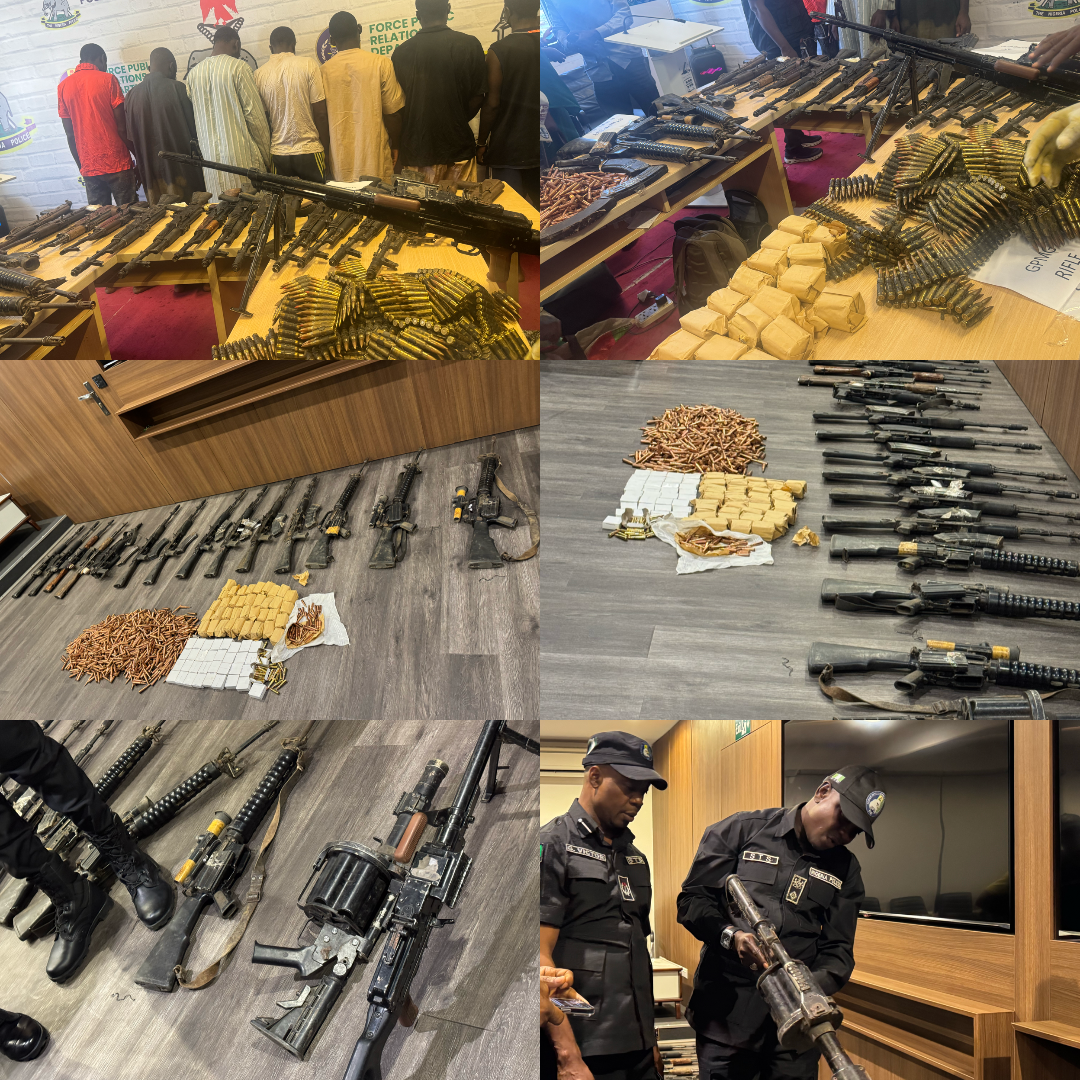
The search that followed produced a haul that investigators believe could help unravel more of the network. Police recovered seven AK pattern rifles, three M16 CQ rifles, a grenade launcher, seven empty magazines and a maroon Kia Sorento vehicle with registration number BWR 598 DY.
According to the operational report, the recovered weapons were allegedly destined for a notorious terrorist identified as Kabiru Baaki at Galadimawa Forest in Kaduna State, giving investigators another potential link between a supplier, the weapons in his possession and the criminal group allegedly waiting to receive them.
Ahmed’s arrest was not treated as an isolated weapons case. It formed part of a wider intelligence led operation targeting an alleged international arms trafficking network operating between the Niger Republic and Nigeria. Between October 10 and November 8, the police arrested three suspects identified as Aminu Ibrahim, 33, Masa’ud Bala, 35, and Ahmed, 43, in a sequence of operations that investigators believe exposed different stages of the alleged supply chain.
Ibrahim was reportedly arrested at Gode Forest along the Mai’adua Koza axis of Katsina State in the early hours of November 7, while a follow up operation in Daura led to the arrest of Bala. Further investigation eventually took operatives to Bauchi, where Ahmed was arrested the following day. Police investigators reportedly identified Bala as the coordinator allegedly responsible for transporting weapons from foreign suppliers, while Ibrahim was said to have handled local deliveries to armed bandit groups.
The significance of the arrests lies not simply in the number of suspects taken into custody, but in the picture of an organised supply chain that has emerged from the investigation. Rather than weapons being moved randomly, police intelligence suggests that different individuals may have been assigned different roles, from sourcing and transportation to local distribution and logistics. Ahmed was consequently described by investigators as a major logistics supplier whose alleged network served criminal groups across three geopolitical zones.
The weapons recovered during the operations provide another indication of the scale of the alleged trafficking network. According to the police briefing, the recovered exhibits included one General Purpose Machine Gun, 16 AK 47 rifles, three M16 CQB rifles and one Milkor grenade launcher. Police also recovered 3,950 rounds of 7.62 x 54mm ammunition and seven empty rifle magazines.
Several vehicles were also recovered, including a maroon Kia Sorento SUV, a red Volkswagen Golf, a black Galaxy van and a red Daylong motorcycle. For investigators, the vehicles may be just as important as the firearms because tracing how they were acquired, used and moved could provide additional information about the movement of weapons and the people connected to the alleged network.
The police said the recovered firearms and ammunition would undergo forensic and ballistic examinations to determine their origins and establish whether they were connected to other criminal activities. Such examinations could potentially help investigators connect weapons recovered from suppliers to previous attacks, providing a wider picture of how firearms circulate between criminal networks and crime scenes.
While the arms trafficking investigation focused on the supply side of violent crime, another FID STS operation targeted a kidnapping syndicate accused of using those weapons to terrorise communities across four northern states. At the centre of that investigation is 35 year old Auwalu Yakubu Kura, popularly known as Bakin Wuta, of Dogarawa, Zaria, whom police identified as the alleged leader of the syndicate.
Other suspects linked to the group include Hamisu Yasu, 35, also known as Auta; Sabo Gambo, 34, popularly called Dan Sabo; and Sulaiman Musa, 27. According to investigators, the syndicate had operated for more than six years, recruiting younger members and allegedly building a criminal network capable of carrying out kidnappings and attacks on communities and vigilante formations.
The group was allegedly connected to the abduction of Alhaji Abdullahi Fika, the All Progressives Congress chairman in Rogo Local Government Area of Kano State, who was later released. Investigators also linked the syndicate to a series of attacks in which vigilantes and civilians were killed, suggesting that the group’s activities went beyond ransom driven kidnappings and extended to attacks designed to weaken local resistance and security structures.
One of the incidents allegedly connected to the group occurred on March 6, 2025, when a vigilante office in Ringim Local Government Area of Jigawa State was attacked. Three operatives, identified as Polo Shuaibu, Inusa Jibrin and Suleiman Manu, were killed, while another operative sustained gunshot injuries.
Investigators also linked the syndicate to the June 17, 2025 killing of Saleh Shuaibu, popularly known as Pia Pia, commander of the Kaduna State Vigilance Service in Anchau, Kubau Local Government Area. Two pump action rifles were reportedly stolen during the attack, adding another layer to the investigation because the weapons themselves became part of what investigators are now trying to trace.
On September 17, 2025, another attack allegedly attributed to the syndicate occurred at the vigilance service office in Zuntu, Kubau Local Government Area. Two operatives, Danladi Dantani and Abdullahi James, alongside a civilian, Zakariya Mansir, were killed. The police also linked the group to the abduction and subsequent murder of Ahmed Yakubu Ruwata, despite the payment of ransom by his family.
The alleged violence extended to places where residents should have been able to gather in safety. Investigators linked the syndicate to an attack on worshippers at a mosque in Ikara Local Government Area of Kaduna State, where nine people were killed. Other incidents under investigation include an attack in Zungur, Kubau Local Government Area, on January 1, 2026, and multiple abductions reported in Gubuchi, Makarfi Local Government Area, as well as the Falgore and Pan Beguwa areas of Kubau.
Police said efforts were continuing to rescue any remaining captives, recover two stolen pump action rifles and apprehend other members of the syndicate. For communities affected by the alleged attacks, however, the arrests represent more than a police operation. They offer the possibility of finally identifying the individuals and networks believed to have been responsible for years of fear, loss and disruption.
The troubling question of diverted ammunition
Running alongside the wider arms trafficking investigation is another case that has raised questions about access to military ammunition. On November 9, 2026, police arrested a serving Nigerian Army Staff Sergeant identified as Abdullahi Muhammad, an instructor at Jaji Military Cantonment in Kaduna State.
According to the operational situation report, Muhammad was arrested at about 9 p.m. in Jaji, Zaria, while allegedly attempting to sell 1,050 rounds of unexpended 7.62mm ammunition to suspected non state actors. A red Honda vehicle bearing registration number ABU 173 AA was also recovered during the operation.
The case has drawn attention because of the suspect’s reported military affiliation and his alleged access to ammunition. Investigators are expected to establish how the ammunition came into his possession, who the intended buyers were and whether other individuals were involved. The outcome could help determine whether the alleged transaction was an isolated incident or part of a broader pattern of diversion.
Taken together, the operations illustrate a significant dimension of Nigeria’s ongoing security challenge. Criminal groups require more than weapons to survive. They need ammunition, transportation, information, money, communication and people capable of moving supplies without attracting attention. Disrupting any of those links can make it more difficult for the groups to operate.
That is why the recent arrests are potentially significant beyond the number of suspects detained or firearms recovered. If investigators can successfully trace the weapons, identify the financiers and uncover the people responsible for moving supplies between borders, forests and communities, the operations could begin to weaken the criminal ecosystem that has sustained violence across parts of northern Nigeria.
The strategy also places greater importance on intelligence gathering. The arrests in Katsina, Daura and Bauchi were reportedly linked through information gathered during the investigation, demonstrating how intelligence can turn what might initially appear to be separate criminal cases into a wider picture of an organised network.
The operations reflect the broader emphasis of Inspector General of Police Olatunji Rilwan Disu on intelligence led policing and the disruption of criminal networks. Rather than focusing only on the perpetrators who appear at crime scenes, the approach seeks to identify the people who provide the resources that allow those perpetrators to operate.
But the real test will come after the arrests and weapons recoveries. Investigators will need to establish the full extent of the networks, identify additional suspects, trace the origins of the firearms and ammunition, recover more weapons and build cases strong enough to withstand prosecution.
For communities that have lived with kidnapping, banditry and attacks for years, success will ultimately not be measured by photographs of seized rifles or the number of suspects paraded after an operation. It will be measured by whether criminal groups lose access to weapons, whether kidnapping routes are disrupted and whether residents can move, farm, worship and conduct their businesses without living under the constant threat of violence.
The latest operations therefore point to a battle taking place beyond the visible gunfights. It is a battle for the supply lines, the logistics, the routes and the networks that keep violent criminal organisations alive. As police investigators follow those trails, the most important question may no longer be only who pulled the trigger, but who made sure the trigger had a weapon behind it.

