

Rivers governor recalls police chief’s handling of political crisis as commissioner, saying his professionalism earned him recognition and a return to the state in a higher capacity.
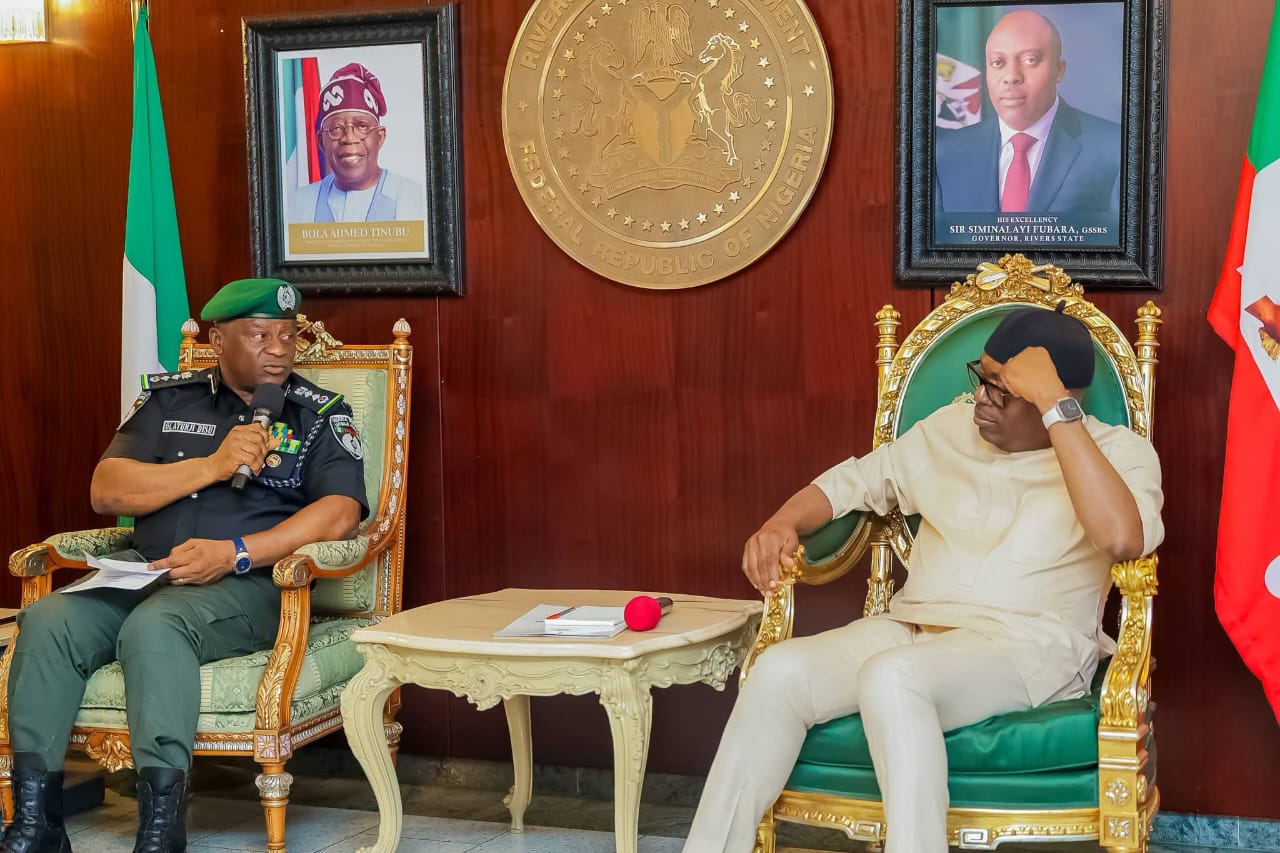
Rivers State Governor, Siminalayi Fubara, has credited the professionalism and commitment to duty of the Inspector-General of Police, Olatunji Rilwan Disu, for his elevation to the nation’s highest police office, recalling how the police chief navigated a turbulent political crisis while serving as Commissioner of Police in the state.
Fubara spoke on Tuesday when Disu paid him a courtesy visit at Government House, Port Harcourt, during an official visit to Rivers State. The governor expressed delight at receiving the IGP, who previously served in the state during a period of intense political tension, describing his return in a higher capacity as a moment of pride.
“I want to thank you for serving us well, and that service is what propelled you to this very exalted position that you occupy today,” Fubara said, recalling Disu’s conduct when he was responsible for maintaining law and order amid the political crisis.
The governor said Disu had remained committed to his constitutional responsibilities despite the difficult circumstances surrounding his assignment, adding that his ability to maintain balance while discharging his duties was worthy of recognition.
“I feel very happy that somebody who left here in a very difficult situation, in a very trying time, is here today visiting us in a higher capacity. Honestly, I feel very happy,” he said.
Fubara recalled that Disu served as commissioner at the height of the political crisis, when tensions between political actors in Rivers State placed significant demands on the police command. He said the officer continued to perform his duties without allowing the prevailing situation to undermine his responsibilities.
“While he was here as Commissioner of Police, it was at the peak of a crisis, but I can tell you that he did his work not minding the situation. He tried as much as he could to balance all areas,” the governor said.
Disu assumed office as Rivers State Commissioner of Police in November 2023, succeeding Emeka Nwonyi, at a time when the political dispute between Fubara and his predecessor, Nyesom Wike, had escalated into a major security concern. The crisis included tensions surrounding the Rivers State House of Assembly and protests that raised concerns about public safety and the potential breakdown of law and order.
In an interview in March 2024, Disu said he relied on what he described as “native intelligence” to manage the situation, explaining that his responsibility was to maintain law and order, protect lives and property, and avoid taking sides in the political dispute.
He said he reminded himself that the political actors involved were from the same state and that the disagreements would eventually be resolved, stressing that his responsibility as a police officer was to remain focused on his duty rather than align with any faction.
Fubara had also publicly commended Disu’s conduct before his elevation to the position of Inspector-General of Police. In September 2024, the governor praised the then commissioner for his handling of the crisis, saying, “Without this man being professional, this state would have been destroyed.” He also described Disu as a balanced officer who had found himself in a difficult situation.
At Tuesday’s meeting, Fubara described the IGP’s return to Rivers State as a homecoming, saying officers who serve a place meritoriously become part of its history and are remembered for their contributions. He added that posterity would remember Disu’s role during his administration when the history of the period was written.
The governor also acknowledged the challenges facing Disu in his current position, particularly the security demands associated with the forthcoming 2027 general elections. He said the country was approaching another critical period and expressed hope that the IGP would receive the support and wisdom needed to discharge his responsibilities.
“You are taking this new office at a very difficult time too, considering the challenges we are already facing in this country and the one we are about to enter into, which is the election. I strongly believe that God will give you the grace to surmount that challenge,” Fubara said.
He assured Disu of the Rivers State Government’s continued cooperation with the Nigeria Police Force, pledging support for efforts to maintain law and order and address security concerns across the state. The governor also prayed for the IGP’s success, expressing the hope that he would continue to progress in his public service career.
In his response, Disu thanked Fubara and the people of Rivers State for their cooperation during his tenure as commissioner, saying effective policing would be difficult without the support of the state government and the communities being served.
The IGP commended residents for sustaining peace in the state and acknowledged the government’s support for the security sector. He also expressed appreciation for the assistance being extended to his successor, noting that cooperation between the government and security agencies remained essential to maintaining stability.
Disu’s visit also coincided with his attendance at the launch of a book by Dame Stella Obuoforibo Okuyiga, a retired Deputy Inspector-General of Police and one of the pioneer women who joined the Nigeria Police Force in 1955.
The IGP described Okuyiga as a living monument whose career formed part of the history of women in Nigerian policing. Her book documents her journey in the force and the experiences of the early generation of female police officers.
The visit brought Disu back to a state where his tenure as commissioner was shaped by political tension and the demands of maintaining security. Fubara’s remarks underscored the importance he attached to the officer’s handling of that period, even as Disu now assumes responsibility for leading the Nigeria Police Force through the country’s wider security challenges and preparations for the 2027 elections.

