
The Centre for Energy Governance and Public Finance Accountability has dismissed claims by the African Democratic Congress (ADC) that President Bola Ahmed Tinubu exceeded his constitutional powers by approving the reconciliation and removal of legacy balances owed by the Nigerian National Petroleum Company Limited (NNPC Ltd) from the Federation Account.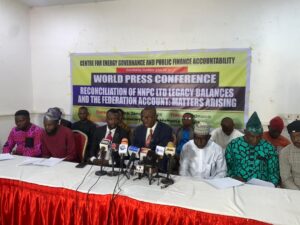
Speaking at a press conference on Friday at the Transcorp Hilton, Abuja, the Centre described the ADC’s allegations as misleading, insisting that the action did not amount to debt forgiveness but a long-overdue fiscal reconciliation exercise aimed at correcting accounting distortions.
The controversy followed the President’s directive to remove about $1.42 billion and N5.57 trillion in long-standing entries from the Federation Account. According to the Centre, these balances had accumulated over several decades and were linked to unresolved production sharing contract disputes, fuel subsidy-related domestic crude supply obligations, royalty assessment disagreements, and reconciliation gaps predating the Petroleum Industry Act (PIA).
Executive Director of the Centre, Dr Opialu Fabian, explained that the disputed figures were never collectible revenues but legacy accounting entries that had remained on government books despite repeated audits questioning their validity and legal enforceability.
“These balances are not recent revenues generated under the current administration,” Fabian said. “They are historical legacy entries, many of which arose before the enactment of the PIA. Treating them as assured income distorted public finances and created unrealistic revenue expectations for federal, state, and local governments.”
The ADC had cited Section 162 of the 1999 Constitution, arguing that the President lacked the authority to approve the removal of the balances without legislative involvement. However, the Centre countered that the constitutional provision applies only to valid and payable revenues, not disputed or unverifiable claims.
According to the group, official records show that the reconciliation process involved key fiscal institutions, including the Federation Account Allocation Committee (FAAC), and applied strictly to balances accumulated up to December 31, 2024. No actual cash, it stressed, was withdrawn from allocations to any tier of government.
The Centre further noted that the exercise aligns with the PIA’s reform objectives of transforming NNPC Ltd into a commercially oriented entity operating under international accounting standards, while improving fiscal transparency and predictability in public finance management.
“Contrary to claims of an arbitrary executive write-off, this was a structured, multi-institutional reconciliation process,” Fabian added. “Removing these distorted figures ultimately benefits all tiers of government by providing a more accurate and credible basis for revenue projections.”
About Author


