
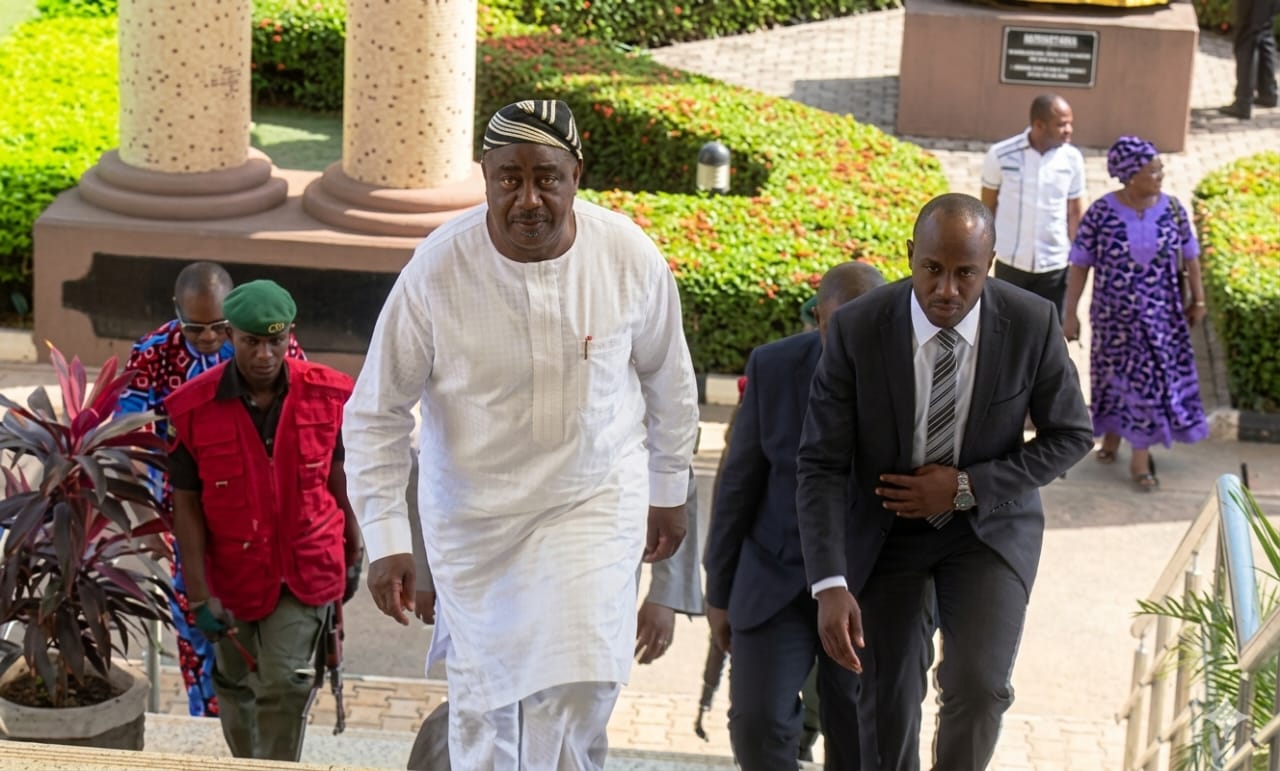
Former Benue State Governor, Gabriel Suswam, and his former Commissioner for Finance, Omadachi Oklobia, are set to enter the final phase of their prolonged N3.1 billion money laundering trial as a Federal High Court in Abuja has fixed May 29, 2026, for the adoption of final written addresses.
The case, instituted by the Economic and Financial Crimes Commission (EFCC), has lingered in court for over 11 years and centres on allegations surrounding the sale of Benue State Government shares in Dangote Cement Plc through Elixir Securities Limited and Elixir Investment Partners Limited.
Justice Peter Lifu of the Federal High Court, Abuja Division, fixed the date after the defendants concluded their defence in the 11-count amended charge bordering on alleged money laundering and diversion of public funds.
The anti-graft agency first arraigned Suswam and Oklobia in November 2015 before Justice Ahmed Mohammed over allegations that they diverted proceeds from the sale of Benue State-owned shares valued at N3.1 billion.
The defendants were later re-arraigned on November 2, 2020, on amended charges accusing them of violating provisions of the Money Laundering Act through multiple cash transactions exceeding the legally permitted threshold.
The trial suffered repeated setbacks over the years following the withdrawal of Justice Ahmed Mohammed after allegations published by Sahara Reporters claimed he had been compromised. Although he initially returned to the case after intervention by parties involved, he later withdrew again in 2019 following fresh allegations.
The matter was subsequently reassigned to Justice Okon Abang before eventually landing before Justice Peter Lifu after Justice Mohammed’s elevation to the Court of Appeal in 2023.
Proceedings commenced afresh on March 21, 2024, before Justice Lifu following the EFCC’s amended 11-count charge.
To establish its case, the EFCC called nine witnesses, including officials from the Benue State Ministry of Finance, investigators from the EFCC, stockbrokers, and bureau de change operators.
One of the key witnesses, bureau de change operator Abubakar Umar, told the court that he converted N3.1 billion allegedly linked to the defendants into $15.8 million and delivered the cash to Suswam at his Maitama residence in Abuja in 2014.
According to Umar, the money was transferred into his Zenith Bank account in tranches by a female proxy allegedly acting on Suswam’s instruction.
He narrated before the court that the first tranche of N413 million was transferred on August 8, 2014, while subsequent transfers brought the total amount to N3.1 billion.
The witness claimed he converted the funds at an exchange rate of N197 per dollar and personally delivered the cash to Suswam in Abuja.
Another prosecution witness, EFCC investigator Mustapha Yusuf Abubakar, tendered documents linking the Benue Investment and Property Company Limited to stockbroking agreements signed by Oklobia as commissioner for finance.
The investigator also alleged that Oklobia collected N350 million in two tranches and handed the money to a security aide attached to the then governor.
After the EFCC closed its case in May 2025, the defence filed a no-case submission, arguing that the prosecution failed to establish sufficient evidence against the defendants.
However, on July 23, 2025, Justice Lifu dismissed the application, ruling that the prosecution had established a prima facie case requiring the defendants to open their defence.
“The defendants need to throw some light on some of the allegations made against them in the interest of justice and fair hearing,” the judge ruled.
Opening his defence, Suswam denied all allegations against him, insisting he neither collected money from Abubakar Umar nor instructed anyone to do so on his behalf.
Describing himself as “a lawyer by training, a politician by choice and a businessman by necessity,” the former governor maintained that he never misappropriated public funds during his tenure.
He also told the court that aside from his official salary as governor, he earned legitimate income from rice farming, rice milling, and cattle rearing.
Oklobia, on his part, urged the court to discharge him, arguing that his actions were carried out based on directives allegedly issued by Suswam.
Although the matter was initially scheduled for adoption of final written addresses on January 20, 2026, proceedings could not hold due to the absence of the trial judge.
Court records now show that May 29, 2026, has been fixed for parties to adopt their final addresses ahead of judgment.
For anti-corruption observers and many Benue citizens whose government shares in Dangote Cement Plc formed the basis of the allegations, attention is now firmly fixed on the long-awaited conclusion of a case that has traversed three judges over more than a decade.
About Author


