

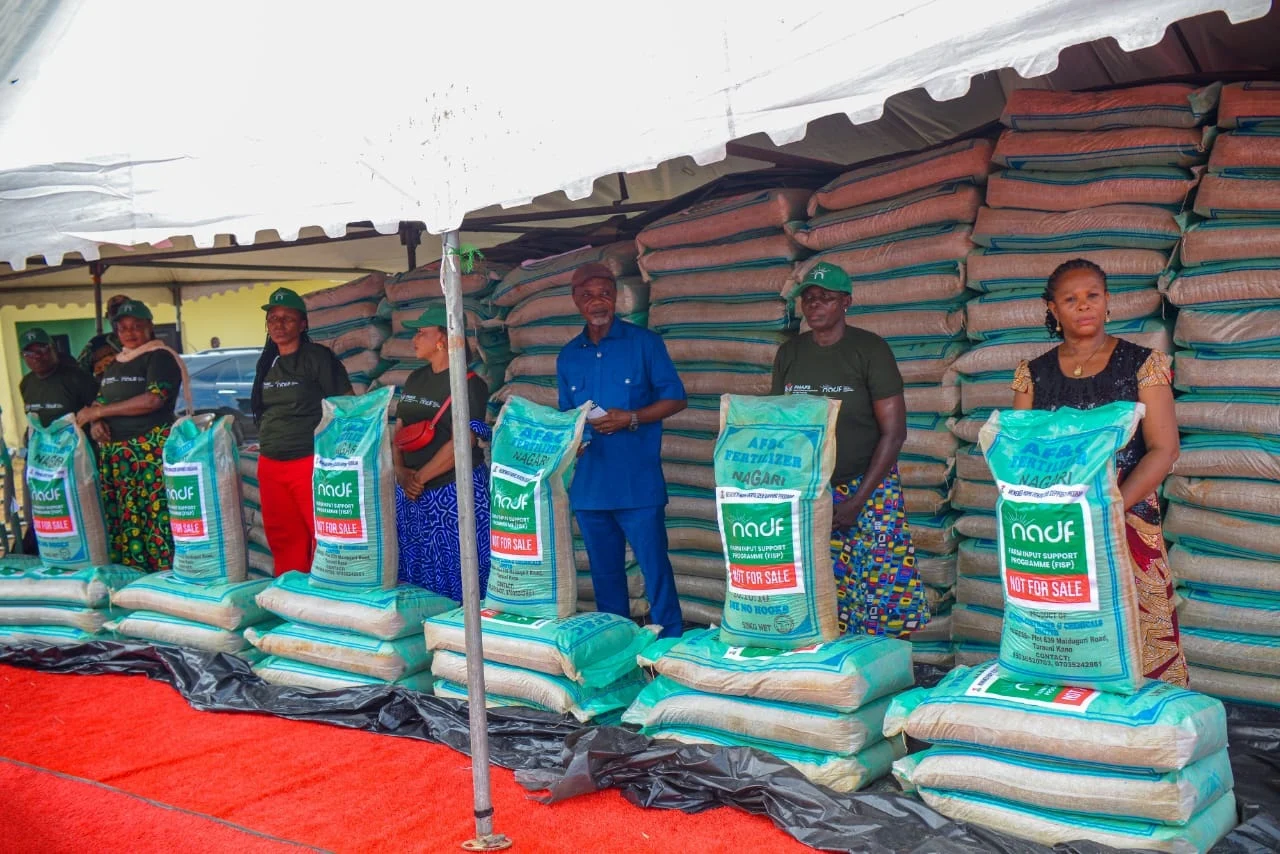
The National Agricultural Development Fund (NADF) has launched the distribution of 80,640 bags of fully subsidised fertiliser to 20,160 smallholder farmers across Nigeria’s South-South region, in a move aimed at boosting farm output, reducing production costs, and strengthening food security in Nigeria.
The official flag-off took place in Calabar, Cross River State, covering beneficiaries in Cross River, Akwa Ibom, Delta, and Edo States under the Fund’s Farm Input Support Programme (FISP).
Speaking at the event, NADF Executive Secretary and CEO Mohammed Ibrahim, represented by Olalekan Alabi, Head of the Investment Department, said the initiative reflects President Bola Ahmed Tinubu’s Renewed Hope Agenda for agriculture. He explained that farm input support in Nigeria must be targeted to ensure real impact on productivity and livelihoods.
According to him, the FISP programme in Nigeria is not a general distribution scheme but a focused intervention that delivers fertiliser directly to verified farmers growing priority food crops.
“FISP is not a blanket intervention. It is targeted support designed to get fertiliser to the right farmers, for the right crops and at the right time. Agriculture should be measured by higher yields, improved market access and the impact it makes on people’s lives,” he said.
Ibrahim confirmed that the programme will support 128,930 smallholder farmers nationwide, with 515,720 bags of fertiliser to be distributed. Each South-South state will receive 20,160 bags, benefiting 5,040 farmers per state, with each farmer getting four bags.
He added that all fertiliser is locally produced, fully subsidised, traceable, and marked “Not for Sale” to prevent diversion. Every bag has been linked to verified beneficiaries through screening and documentation, while monitoring teams will evaluate productivity after the farming season.
The NADF also announced plans to deploy over 1,800 extension advisory workers nationwide, with 30 assigned to each state. It is also finalising a Fertiliser Recommendations Manual for Nigerian crops to guide proper application and improve yields.
Representing Governor Bassey Otu, Speaker of the Cross River State House of Assembly, Rt. Hon. Elvert Ayambem, praised the initiative and said smallholder farmers remain central to Nigeria’s agricultural economy. He pledged transparency in distribution and encouraged farmers to use the inputs responsibly to maximise output.
Minister of Agriculture and Food Security Senator Abubakar Kyari, represented by Sampson Maddy George, said the programme helps bridge Nigeria’s agricultural productivity gap and strengthens food production in Nigeria.
“One programme delivers three gains: support for the farmer, increased demand for local fertiliser producers and improved food security for the nation,” he said.
He added that the scheme builds on the FISP-AgGrow-1 Programme and supports the Federal Government’s push for food sovereignty in Nigeria, following the declaration of a state of emergency on food security in 2023.
Cross River State Commissioner for Agriculture Johnson Andiambey Ebokpo also said the programme aligns with state-level agricultural reforms, including mechanisation support, improved seedlings, and farmer training initiatives.
He stressed that stronger cooperation between federal and state governments will drive higher productivity, better rural incomes, and improved food security in Nigeria.

