
By peterside Rejoice
The Federal Ministry of Solid Minerals Development came under intense scrutiny on Monday as lawmakers called for the sector to be placed on first-line charge, warning that persistent zero capital releases are undermining Nigeria’s N1 trillion mining ambition.
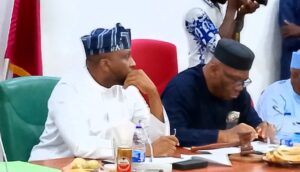
The Minister of Solid Minerals Development, Henry Dele Alake, appeared before the National Assembly Joint Committee on Solid Minerals Development to present the Ministry’s 2024 budget performance and projections for 2026.
The session, jointly chaired by Senator Ekong Sampson and Hon. Jonathan Gaza Gbefwi, shifted from a routine budget defence to a broader debate on funding sustainability and the strategic importance of the mining sector to Nigeria’s economic diversification drive.
Lawmakers expressed concern that despite ambitious projections and a previously announced N1 trillion intervention framework for the sector, the absence of capital releases is stalling implementation of critical projects.
A central proposal that emerged during the session was the call to place the Ministry on first-line charge, a funding status that prioritizes allocations in a manner similar to constitutionally protected expenditures. Committee members argued that such a move would shield the sector from inconsistent treasury releases and ensure predictable funding.
One lawmaker described the mining sector as highly sensitive and strategic, stressing that Nigeria cannot afford to neglect its vast mineral deposits at a time when the country is seeking to reduce dependence on oil revenue.
The committee questioned how meaningful development could occur in the face of zero capital releases, describing the situation as worrisome. Members noted that while budgetary figures may appear robust on paper, the lack of actual cash backing weakens execution capacity and risks eroding investor confidence.
In his response, Alake openly endorsed the proposal to grant the Ministry first-line charge status, describing it as welcome and long overdue. He urged the legislature to initiate the necessary processes to institutionalize funding priority for the sector.
He emphasized that achieving the Ministry’s mandate of early and sustainable development of Nigeria’s mineral resources, environmental sanitation, and global competitiveness depends heavily on access to scientifically certified geological data and sustained financial support.
According to the Minister, internationally certified geological data is essential to attracting serious global investors. He disclosed that recent geological data acquisition efforts have already enhanced Nigeria’s credibility in international mining circles.
Despite funding challenges, Alake presented performance figures indicating strong progress in 2024. Of the N31.24 billion appropriated for the year, about 81 per cent was released and utilized. He also revealed that against a revenue target of N11.8 billion, the Ministry generated over N28 billion, representing a 139 per cent increase above projections.
The Minister further reported significant enforcement achievements. More than 350 illegal miners were arrested, with over 150 prosecuted through strengthened Mine Marshals operations aimed at sanitizing the sector.
In addition, the Ministry has intensified efforts to formalize artisanal and small-scale miners by organizing them into cooperatives. Alake explained that the initiative is designed to improve regulation, enhance access to financing, and boost royalty and tax collection for government.
He disclosed that Nigeria’s artisanal mining model is drawing attention from other African countries, with a minister from another African nation planning a visit to understudy the framework.
While acknowledging these strides, lawmakers cautioned that inconsistent capital releases could undermine investor enthusiasm. They observed that Nigeria has recorded strong investor interest at international mining forums but stressed that funding certainty is crucial to sustaining that momentum.
The committee chair noted that there is compelling logic in prioritizing the solid minerals sector, arguing that placing it on first-line charge would signal seriousness of purpose and strengthen investor confidence.
With the 2026 budget proposal largely reflecting a rollover of 2025 figures, Alake appealed for clarity regarding service-wide provisions and urged lawmakers to support efforts to secure timely and predictable treasury releases.
He warned that without stable funding, the Ministry’s capacity to expand geological mapping, reclaim abandoned mine sites, deepen regulatory reforms, and scale up value chain development could be significantly constrained.
As deliberations continue, the proposal to elevate the Solid Minerals Ministry to first-line charge status is shaping up as a defining policy debate, one that could determine whether Nigeria’s vast mineral wealth becomes a transformative pillar of economic growth or remains largely untapped.
About Author


