

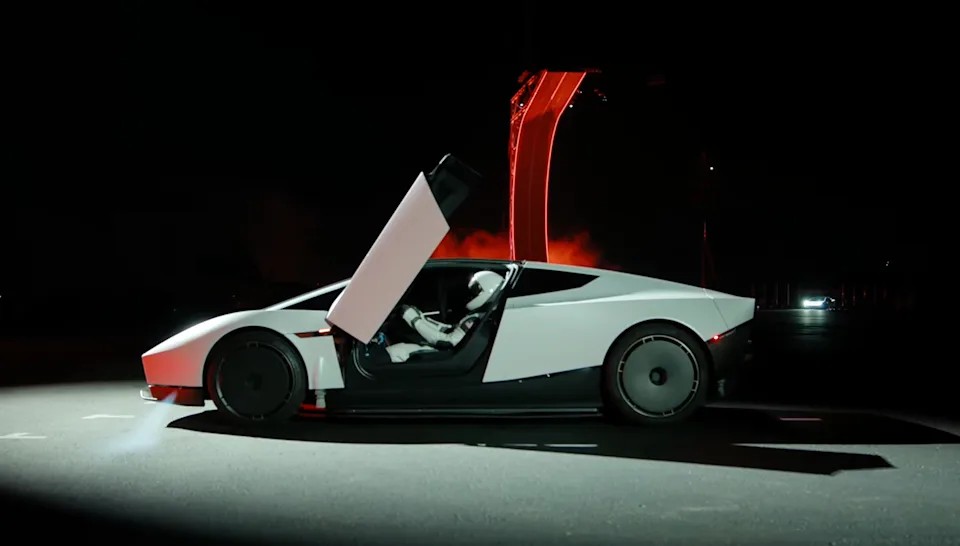
Tesla’s new Tesla Roadster has grabbed attention with a dramatic demonstration featuring an upside-down ramp jump, mid-air flips and thrusters designed to help the electric car land safely.
The long-awaited vehicle made its appearance at a demonstration held at SpaceX’s facility in Waco, Texas, two weeks after Tesla postponed the original October 1 unveiling. The wedge-shaped sports car climbed partway up an inverted roller-coaster-style ramp using a vacuum fan system before launching into the air. It then performed flips and used air thrusters to return to an upright position and land on the tarmac.
Tesla chief executive Elon Musk summed up the stunt with a brief remark: “Well, it worked,” he said.
The event also featured a second demonstration in which the Roadster jumped over several Tesla vehicles, including a semi-truck, before turning upside down and using its thrusters to land. Tesla presented the manoeuvre as a first for an automaker.
The display attracted investor interest, with Tesla stock (TSLA) rising by more than four per cent in pre-market trading on Friday following the event.
Tesla also demonstrated the car’s acceleration, claiming it could travel from zero to 60 miles per hour in just 0.81 seconds. The company listed different performance targets for its three planned configurations, with the fastest version expected to deliver even quicker acceleration.
The automaker has claimed a top speed of up to 230 mph, while Musk suggested that the production model could potentially target Mach 0.5, or approximately 383 mph. However, this higher speed remains a stated ambition rather than a confirmed production specification.
Despite the dramatic demonstration, buyers will have to wait before they can take delivery. Musk said production would begin in 2028, extending the timeline for a vehicle first announced several years ago.
Tesla has outlined three versions of the electric sports car, each designed for different levels of performance and functionality.
- Performance: A road-focused, two-seat model featuring a multi-mode suction system intended to improve performance on and off the track.
- Thrust: A two-seat, track-focused version that adds rear-mounted cold-gas thrusters to the suction system, with acceleration advertised at under 0.9 seconds from zero to 60 mph.
- Rocket: A single-seat configuration equipped with perimeter-mounted cold-gas thrusters designed to support forward and upward acceleration, as well as sideways rotation.
Tesla said all three configurations would offer a range exceeding 300 miles. The company listed acceleration targets of under 1.6 seconds for the Performance model, under 0.9 seconds for Thrust and under 0.59 seconds for Rocket. The Rocket version was also advertised with a top speed of up to 230 mph.
The proposed thruster system raises questions about how the Rocket version might operate legally on public roads, particularly if its design allows brief periods of flight. Tesla has not yet explained how regulators would handle these capabilities.
The unveiling followed a two-week delay, which Tesla attributed to weather conditions at SpaceX’s Rocket Development and Testing facility in Waco.
Prospective buyers must pay a $5,000 deposit, followed by a $45,000 wire transfer within 10 days of the initial payment. Tesla has not announced an official price for the new Roadster, although expectations place it above $250,000.
The vehicle’s history adds to the anticipation. Tesla introduced the original Roadster in 2008, using a Lotus Elise chassis, and sold it until 2012. The company announced a successor in 2017 and initially expected deliveries to begin in 2020. Customers who placed early reservations have therefore faced a lengthy wait.
Musk addressed the car during an appearance at the All-In Summit in September, promising an exciting product while acknowledging uncertainty about its ultimate success.
“It’ll be a banger. Excitement guaranteed. Success is not guaranteed, but excitement is,” he added.
Gene Munster of Deepwater Management, a Tesla supporter, identified two main messages from the demonstration. In a post on X, he described it as an engineering showcase with little commercial value beyond challenging traditional carmakers, while suggesting that Musk wanted to bring Tesla and SpaceX closer together.
The event has certainly generated attention, but questions remain about production timing, final specifications, pricing and the practical use of the Roadster’s unusual technology.
With production targeted for 2028 and a potential price above $250,000, will Tesla’s extraordinary performance claims be enough to turn the Roadster from a spectacular demonstration into a commercially successful electric supercar?

