
By Rejoice Peterside
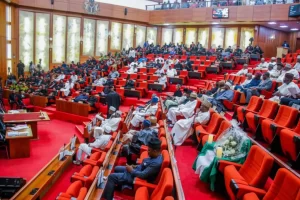
The Senate, on Thursday, November 13, 2025, passed for second reading a bill seeking to repeal and re-enact the Armed Forces Act, to provide a modern, constitutionally compliant, and operationally responsive legal framework for the Nigerian military.
The bill, titled A Bill for an Act to Repeal the Armed Forces Act and to Re-enact a Modern, Constitutionally Compliant and Operationally Responsive Legal Framework for the Armed Forces of the Federal Republic of Nigeria, and for Related Matters, 2025 (SB. 791), was sponsored by Senator Abdulaziz Yar’adua, representing Katsina Central Senatorial District.
Leading debate on the general principles of the bill during plenary, Senator Yar’adua said the existing Armed Forces Act rooted in military decrees of the 1960s and last consolidated in 2004 was outdated and no longer reflective of Nigeria’s current constitutional and security realities.
He noted that the Nigerian Armed Forces remain the cornerstone of national sovereignty and security, playing a vital role in combating insurgency, terrorism, and other internal and external threats, as well as participating in regional peacekeeping operations across Africa.
“Our military law has not kept pace with the evolving defence environment,” Yar’adua stated. “This bill seeks to align military governance with constitutional principles, democratic accountability, and operational modernity.”
According to him, the proposed legislation would overhaul disciplinary and administrative procedures in the military, modernise its operational structures, and ensure the welfare and rights of service members are adequately protected.
He explained that outdated penalties such as ₦200 and ₦500 fines would be replaced with percentage-based sanctions tied to officers’ salary levels, while provisions for fair hearing and extended rights for non-commissioned officers would be introduced to enhance morale and professionalism within the armed forces.
“Countries such as the United States, the United Kingdom, and South Africa have modernised their military laws to reflect justice, accountability, and professionalism,” Yar’adua said. “Nigeria cannot afford to lag behind.”
Supporting the bill, Senator Ali Ndume, representing Borno South, described the reform as long overdue, stressing that the Nigerian Armed Forces must operate under a legal framework that reflects modern realities and democratic values.
“This is the right time to review our military laws in line with the global trend. We must ensure that our armed forces operate with fairness and professionalism,” Ndume said.
Also speaking, Senator Tahir Monguno, representing Borno North, said the bill was a necessary step toward subjecting military institutions to democratic oversight and ensuring compliance with constitutional standards.
“The bill seeks to bring our military laws in tandem with international best practices and under the authority of democratically elected institutions,” he noted.
In his contribution, Senator Samson Ekong, representing Akwa Ibom South, commended the initiative, describing the bill as “a profound principle of reform.”
“The time has come to strengthen our defence policy framework and ensure our armed forces are guided by a modern, just, and accountable legal structure,” Ekong said.
After exhaustive debate, the bill was put to a voice vote by Deputy Senate President, Senator Barau Jibrin, who presided over the plenary. It was subsequently passed for second reading.
Senator Barau referred the bill to the Senate Committees on Defence, Army, Air Force, and Navy for further legislative input, with a directive to report back within four weeks.
He stressed that the need for reform was urgent, noting that laws are not static but must evolve in line with changing national and global realities.
“This is a positive step towards ensuring that our armed forces remain efficient, accountable, and constitutionally guided,” Barau said.
If eventually passed and assented to, the bill will mark one of the most comprehensive legal reforms in Nigeria’s military history, aiming to strengthen professionalism, improve morale, and align the nation’s defence architecture with contemporary global standards.
About Author


