

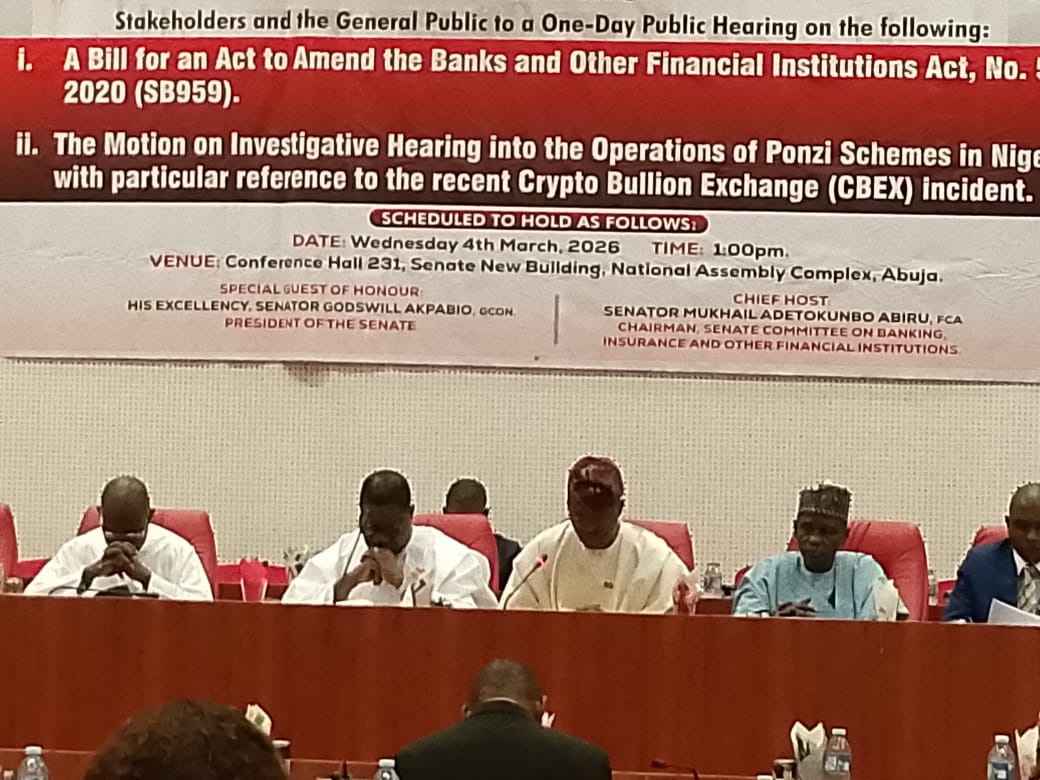
The Senate Committee on Banking, Insurance and Other Financial Institutions has launched a sweeping investigation into the operations of Ponzi schemes in Nigeria following revelations by the Economic and Financial Crimes Commission (EFCC) that about N1.3 trillion was linked to the collapsed Crypto Bullion Exchange (CBEX) scheme.
The disclosure emerged during a one-day public hearing on a motion to investigate Ponzi schemes in Nigeria, with particular focus on the CBEX incident, alongside deliberations on a bill seeking to amend the Banks and Other Financial Institutions Act (BOFIA 2020).
Chairman of the Committee, Mukhail Adetokunbo Abiru, said the proposed amendment and investigative hearing are aimed at closing regulatory loopholes exploited by fraudulent investment operators and unlicensed digital platforms.
Representing EFCC Chairman Olanipekun Olukoyede, the Commission’s Cybercrime Section Supervisor, Dein Whyte, presented findings of the agency’s probe into CBEX and similar emerging schemes.
According to Whyte, CBEX, which began operations in mid-2024, promised investors 100 per cent returns through supposed AI-driven crypto trading. While early projections estimated investor exposure at N1.3 trillion, blockchain analysis traced over $46 million in USDT stablecoin inflows into wallets linked to the scheme.
He explained that promoters encouraged victims to convert naira into digital assets before investing, thereby avoiding direct cash trails. Investigations further revealed that CBEX promoters held aggressive online and physical campaigns and registered a special purpose vehicle with the Corporate Affairs Commission under a different name.
The EFCC disclosed that Nigerian promoters collaborated with foreign partners based in Southeast Asia. Some digital infrastructures have been seized, certain funds frozen, and suspects are currently facing prosecution for operating an unlicensed exchange. The agency also clarified that the operators misrepresented an onboarding certificate from its Special Control Unit Against Money Laundering as full regulatory approval.
During the hearing, lawmakers raised fresh concerns about the increasing use of fintech platforms such as OPay and Moniepoint by fraudsters and kidnappers to receive illicit funds.
Responding, a representative of Moniepoint attributed its widespread usage to accessibility and instant transaction confirmation but acknowledged difficulties in tracing funds when account holders compromise their identities. The company pledged to expand its physical branch network nationwide before 2028 to enhance accountability.
Stakeholders broadly supported the BOFIA amendment but warned against regulatory overlaps, urging harmonisation with existing obligations under the Central Bank of Nigeria framework. Lawmakers also flagged possible inconsistencies with provisions of the Nigerian Communications Act and called for technical review.
The committee resolved to constitute a technical team comprising regulatory experts, legal practitioners, and financial sector stakeholders to refine the proposed legislation.
Senator Abiru stressed that the goal is to deliver “a conclusive and useful legislation” capable of strengthening Nigeria’s financial ecosystem, improving consumer protection, and preventing large-scale investment fraud.
The public hearing comes amid rising concerns over digital investment scams, with the EFCC warning Nigerians against high-yield schemes promising unrealistic returns.

