

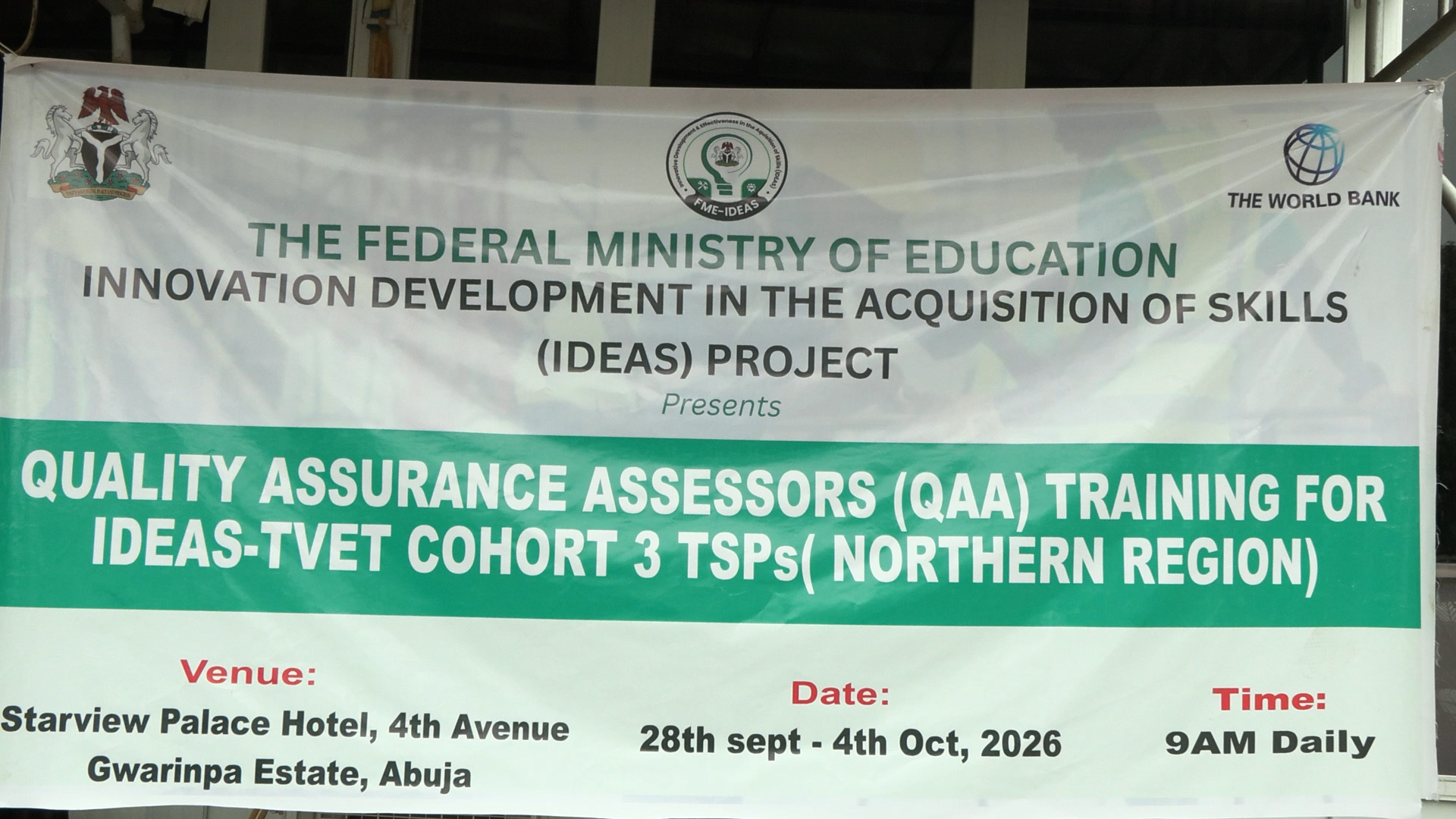
The Federal Government has intensified efforts to strengthen Technical and Vocational Education and Training (TVET) in Nigeria through the training of Quality Assurance Assessors responsible for evaluating the competencies of trainees across different skills.
The training, organised under the Federal Ministry of Education’s IDEAS Project, brought together about 250 Training Service Providers (TSPs) and other stakeholders from the Northern Zone to equip them with the knowledge and tools required to conduct competency-based assessments.
Speaking during the training, Blessing Ehi Ogwu, National Project Coordinator of the IDEAS Project, said the Federal Government was investing significantly in TVET as part of efforts to address unemployment and equip Nigerian youths with practical skills.
According to her, the government is renovating federal technical colleges, while students in federal technical colleges can access free education and boarding-related support under the current initiative.
She said the programme also provides short-term training opportunities for out-of-school youths, with courses lasting between six months and one year, depending on the trade.
Ogwu explained that the current training was not primarily about teaching participants new vocational skills, but about preparing them to properly assess people who had acquired skills through formal or informal training.
“They are being trained on how to assess. We call it Quality Assurance Assessors, so that they don’t just train, but understand the process of assessing the trainees,” she said.
She added that the IDEAS Project was training more than 85,000 trainees across different centres nationwide, while the Federal Government was also funding additional TVET centres.
Ogwu encouraged Nigerian youths to take advantage of government-funded TVET programmes, saying the ultimate objective was to reduce unemployment by helping young people acquire marketable skills.
She said information about the programmes had been disseminated through newspapers, online platforms, churches, mosques and social media, adding that many of the current trainees learnt about the programme and registered online.
Why Quality Assessment Matters
The Zonal Director of the National Board for Technical Education (NBTE) in the South-East Zone, who also spoke during the programme, explained that the assessment component was critical to ensuring that people who acquire vocational skills could obtain recognised certification.
She said the system was designed to assess people who had acquired skills in different areas, including carpentry, jewellery, painting and decoration, fashion design and hospitality etc.
According to her, assessors must understand the approved standards and assessment procedures before certifying a trainee.
She explained that while people could acquire skills through different training methods, the competency-based system establishes standards against which their abilities must be measured.
The official said the training was therefore aimed at bridging the shortage of qualified assessors capable of carrying out competency-based assessments in communities and training centres.
Over 250 Participants Targeted
The official said about 250 candidates were participating in the training and, upon successful completion and qualification, would be able to conduct assessments in different vocational fields.
She said the intervention was particularly important because approved training centres needed qualified assessors to evaluate their trainees before they could obtain the relevant National Skills Qualification (NSQ).
She expressed optimism that the current cohort 3 would perform better because the programme was addressing the shortage of assessors in the system.
Competency-Based Training Different From Academic Assessment
Also speaking, Venerable Timothy Ighodaro, an Quality Vocational skills empowerment Manager with a vocational skills awarding organisation, said competency-based assessment differs from conventional academic examinations.
Ighodaro explained that the National Skills Qualification framework focuses on what an individual can practically do rather than relying solely on theoretical knowledge.
He said Nigeria began developing its National Skills Qualification system in 2012 and that the framework was designed to help produce skilled workers capable of meeting industry requirements.
According to him, assessors are trained to use multiple assessment methods and evidence to determine whether a learner has achieved the required performance criteria.
He argued that strengthening competency-based education would help Nigeria develop its technical workforce and reduce dependence on foreign workers for skilled jobs.
Trainee Calls for More Assessors
Hon. Rosemary Ojochenemi Osikoya, a trainee representing Leefnet Enterprises Limited in Lokoja, described the training as an opportunity for Training Service Providers to understand the requirements for competency-based assessment.
She said one of the major gaps identified was the shortage of qualified assessors.
According to her, an assessor may be required to assess about 15 to 20 people, while some training centres have as many as 150 trainees or more.
She therefore called for sustained government intervention and more training of assessors to meet the growing demand.
Osikoya also urged the government to ensure that the programme was sustained beyond the current intervention, saying newly trained assessors would require continued support, field experience and further certification.
She noted that the training had also created an opportunity for centres to interact with one another and engage directly with regulatory bodies on issues relating to standards, performance and certification.
Government Urged to Sustain TVET Investment
The participants commended the Federal Government and the IDEAS Project for investing in TVET and quality assurance, while calling for more funding and continued capacity building.
The speakers said expanding competency-based technical education and ensuring credible assessment could help bridge skills gaps, improve employability and provide Nigerian youths with practical abilities needed in the labour market.
The training is part of broader efforts to strengthen Nigeria’s TVET system and ensure that vocational skills acquired in training centres and communities are properly assessed, recognised and certified.

