
By peterside Rejoice
Former Speaker of the House of Representatives and ex-Governor of Katsina State, Rt. Hon. Aminu Bello Masari, has called for a more responsible political culture in Nigeria, stressing the urgent need to bridge the widening gap between campaign promises and the realities of governance.
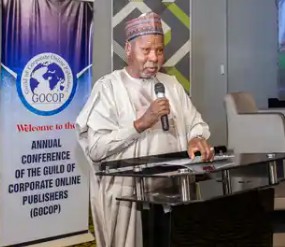
Masari made the call while delivering the keynote address at the 9th Annual Conference of the Guild of Corporate Online Publishers (GOCOP) held on Thursday at the Radisson Blu Hotel, Ikeja, Lagos. The conference, themed “Reconciling Campaign Promises with Governance Realities: Challenges and Prospects,” brought together media executives, public officials, and civil society leaders to deliberate on the intersection between politics, policy, and public accountability.
Speaking at the event, Masari identified four key conditions necessary to bridge the persistent gap between electoral promises and government performance, saying doing so was essential to preserving the integrity of Nigeria’s democracy.
According to him, political actors must campaign with a sense of responsibility, ensuring that promises made to the electorate are realistic, measurable, and achievable within the limits of available resources.
“Unrealistic pledges made merely to capture the mood of the electorate should be challenged and exposed,” Masari stated. “Only then can we begin to elevate our political culture and make sure that the process justifies the end.”
The former governor emphasized that governance must be anchored on strong and capable institutions that can guarantee policy consistency and transparency in implementation. He noted that without effective institutions, even the best policy intentions would fail to deliver meaningful impact.
Masari further stressed the need for honest communication between political leaders and citizens, urging leaders to regularly engage with the public on challenges, trade-offs, and progress made on campaign promises.
“Leaders must explain why certain promises may take longer to fulfil, why resources must be reallocated, and how progress will be measured,” he said.
The fourth condition, according to Masari, lies with the citizens, civil society, and the media, who must also play their part by understanding the realities of governance and accurately communicating those realities. He cautioned against sensational reporting for the sake of social media traction, urging journalists to focus on accountability and fact-based reporting.
“They should track promises and demand transparency instead of creating sensational headlines to attract followers, especially now that the number of followers translates into monetary gain,” Masari noted.
Addressing the obstacles that often hinder the fulfilment of campaign promises, the former governor identified limited resources, competing demands, and unexpected crises as major factors. He said many political manifestos are often aspirational and not grounded in fiscal or institutional realities.
“In many African nations, including Nigeria, budgets are still heavily dependent on a single commodity oil whose price is beyond our control and is shaped by global market forces and geopolitical tensions,” he explained.
Masari cited the COVID-19 pandemic as a clear example of how unforeseen emergencies could force governments to suspend plans and reorder priorities, leading to unmet campaign expectations. He also highlighted insecurity as a major challenge facing Nigeria’s development agenda.
“Insecurity undermines production, disrupts livelihoods, and reduces national revenue. It compels government to divert enormous resources toward security operations,” he said, adding that weak institutions, corruption, and bureaucratic inefficiency further compound the problem.
He warned that when citizens continuously witness promises being made and broken, they lose faith in governance and democracy. However, he noted that even modest progress, when communicated honestly and delivered consistently, can sustain public trust in democratic institutions.
“Let our promises be realistic, our expectations be modest, our governance transparent, and our accountability strong. In doing so, we can transform hope into progress and democracy into a vehicle of real change,” Masari urged.
Masari commended the leadership and members of GOCOP for their consistency in creating platforms for national dialogue and accountability, describing the Guild as a vital bridge between the government and the people.
“This is where journalism, at its best, and more specifically GOCOP in this digital age, becomes indispensable. You and your profession are the bridges between leaders and the people. You shape narratives, hold leaders accountable, and track progress,” he said.
The event also featured the formal handover of leadership within GOCOP, with Danlami Nmodu, mni, emerging as the new president of the Guild, succeeding Dr. Maureen Chigbo, publisher of RealNews Online.
About Author


